
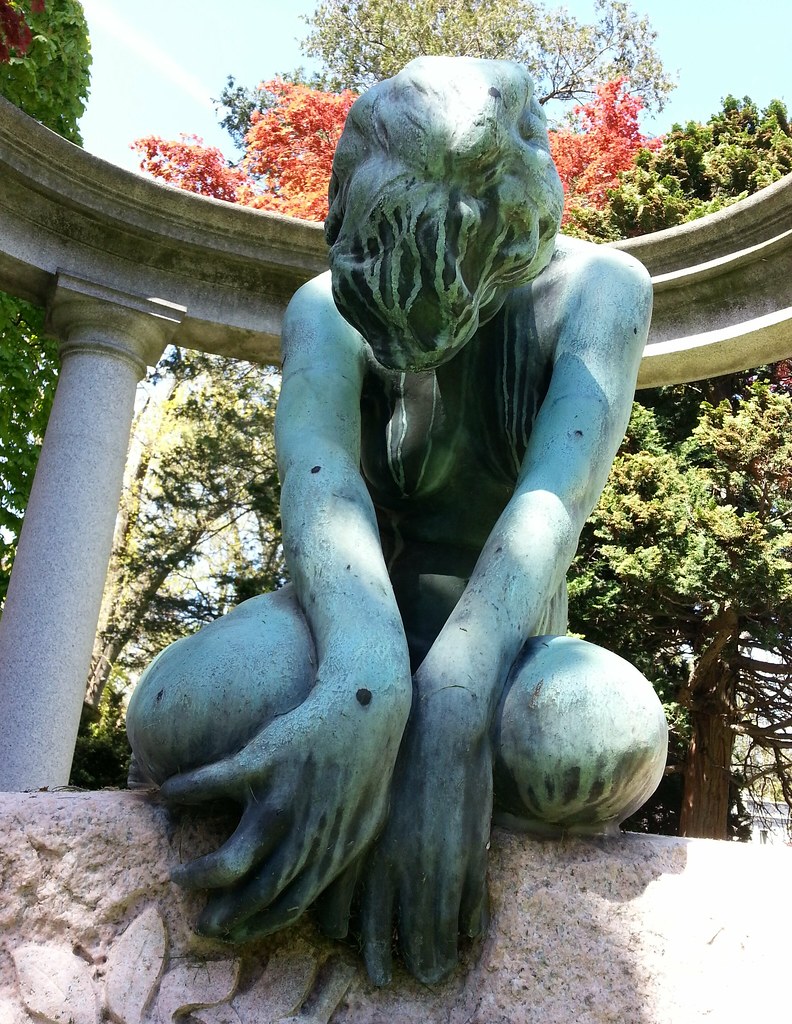
That's the name of this Sally Farnham sculpture marking the graves of Vernon and Irene Castle, a famous ballroom dancing duo who starred in 1914's Watch Your Step, the first Broadway show written by Irving Berlin, a fellow Woodlawner. The Castles' time together was cut short, however, when Vernon, a captain in the British Army's Royal Flying Corps, died in a plane crash while training an American cadet in Texas during World War I.

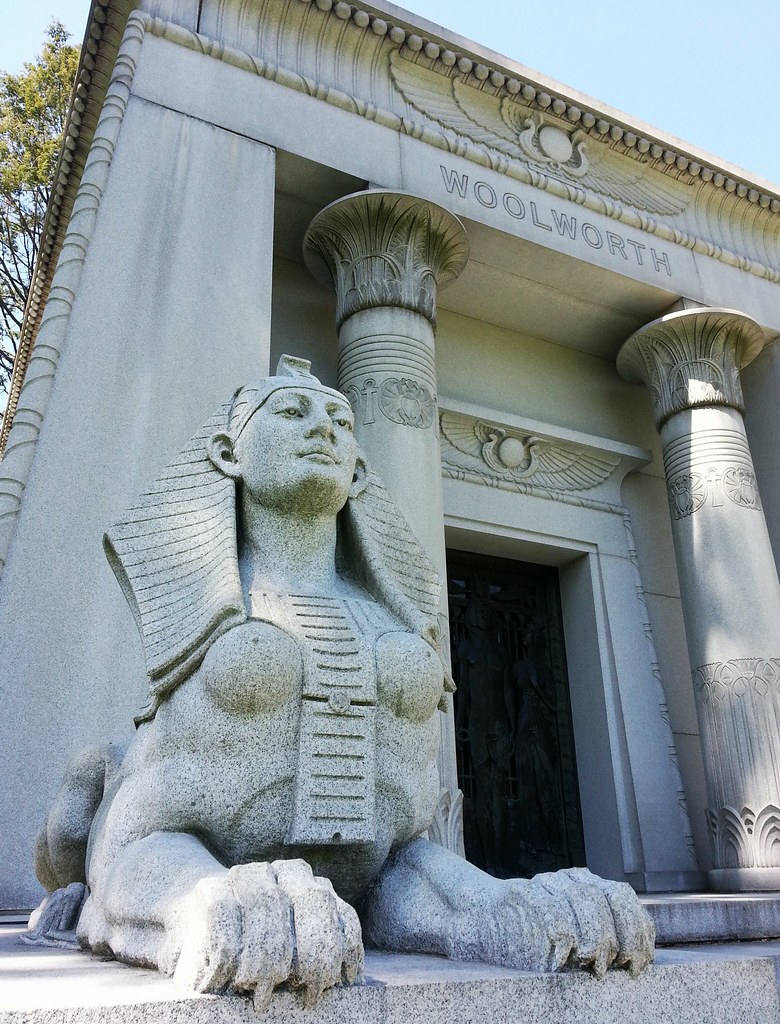
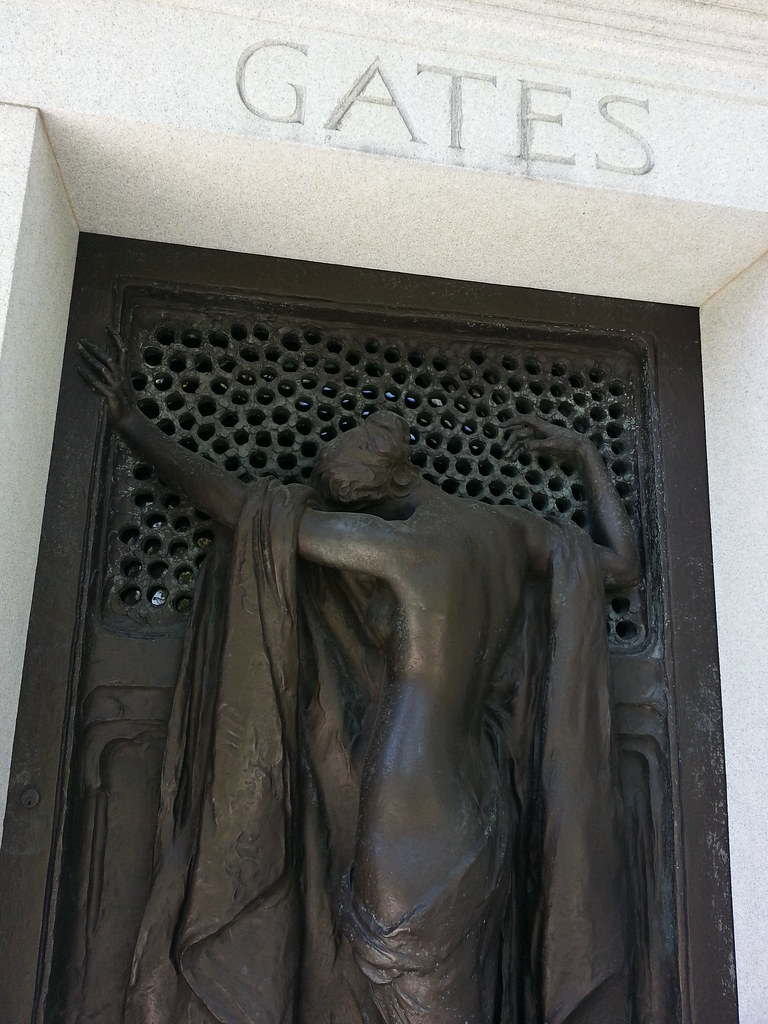
This is one of a pair hanging around the entrance to the mausoleum of Frank Woolworth and his family (including his troubled granddaughter and heiress Barbara Hutton, the "poor little rich girl"). Mr. Woolworth, founder of the five-and-dime empire that bore his name, is one of several members of what Woodlawn calls its "Merchant Prince Hall of Fame"; James C. Penney and Rowland H. Macy, among others, can also be found resting peacefully here in the cemetery, Mr. Penney in a used (or "previously owned") mausoleum that he bought from William Randolph Hearst's widow.
Somewhere in the vicinity, I believe, is the pink granite mausoleum of Elvira and Lawrence Wegielski, which for quite a while was the modern-day version of the Evergreens Cemetery's Reed mausoleum. Mr. Wegielski, who passed away in 2010, would make regular visits to Woodlawn
every Tuesday, Thursday and Sunday, both to care for the site and to spend time with the spirit of his dead wife.There's a beautiful twist at the end of the NY Times's 2003 account of their relationship, from which I've quoted above. Take a read!
''A lot of people say, why do you have to go down to the cemetery three times a week?'' he said. ''This seems to relieve me. I come down, I don't bother anybody, I sit down, I bring soda with me, oranges, whatever. I have lunch with her.''
When the season calls for it, he decorates. Last Christmas, in addition to two ornamented trees, he installed a talking wreath on the door of the mausoleum, so that passers-by who triggered a motion detector were greeted with a hearty ''Merry Christmas.'' One security guard, on night patrol on the pitch-black grounds, was so startled he pulled out his gun. Daytime visitors were alternately spooked and delighted.
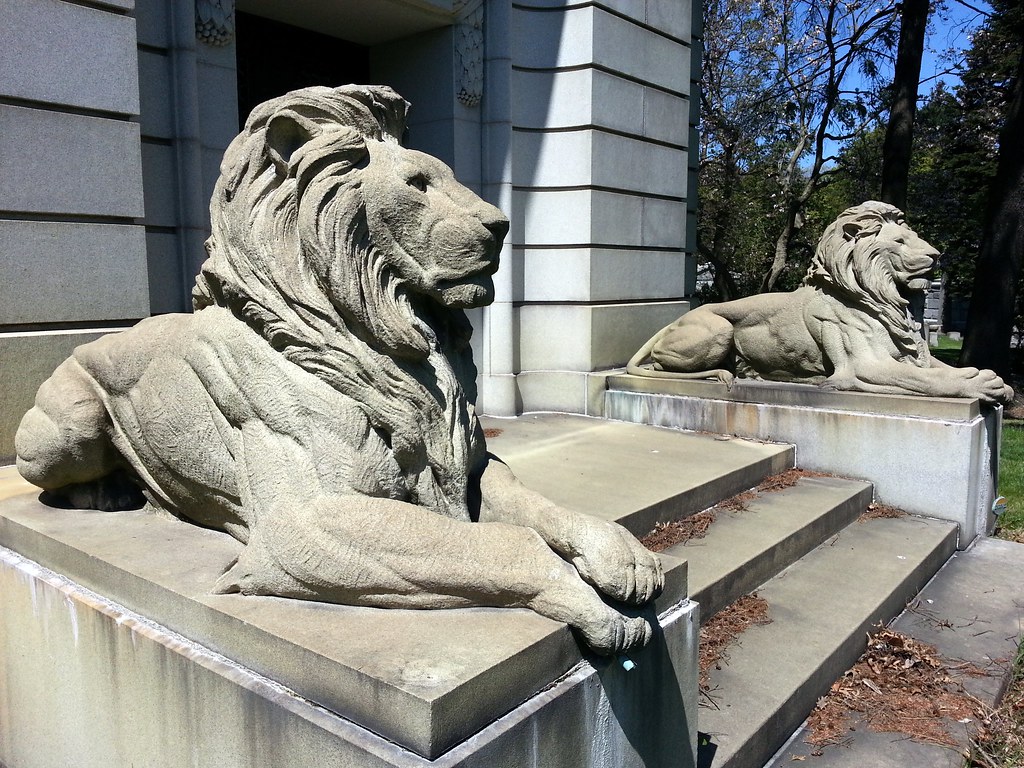
Guarding the tomb of George Ehret, the "King of Beer Corners"
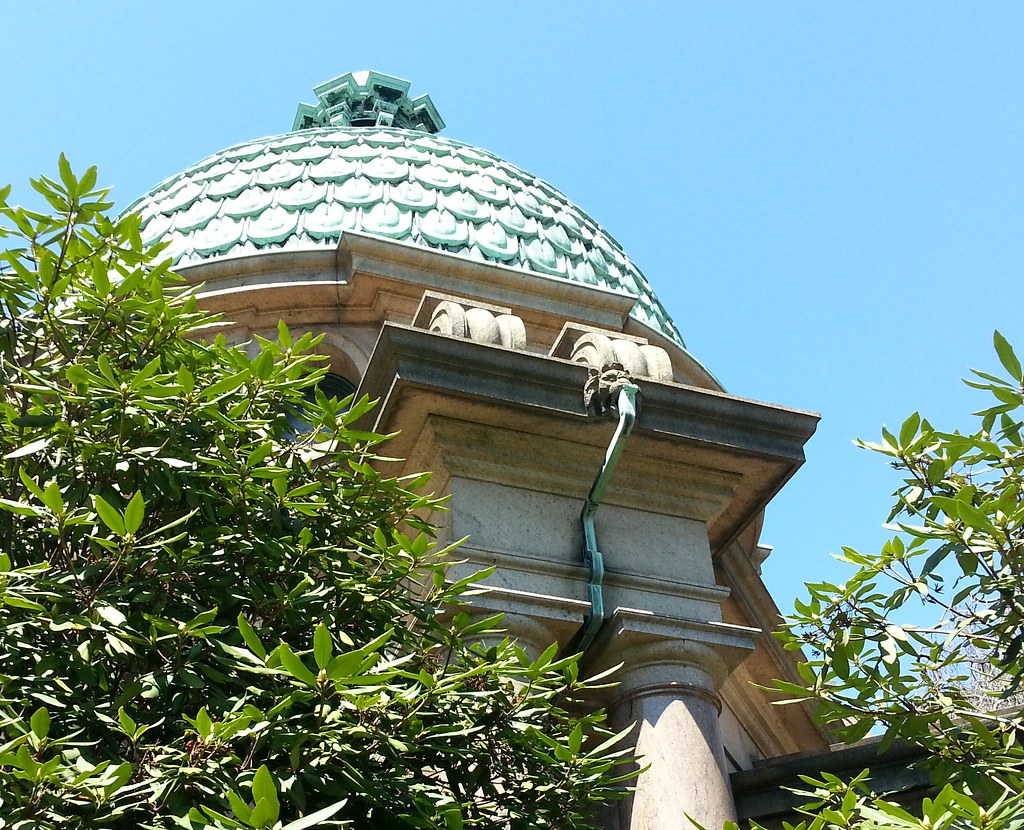
The mausoleum of Herman O. Armour, co-founder of Armour & Company, the meatpacking giant
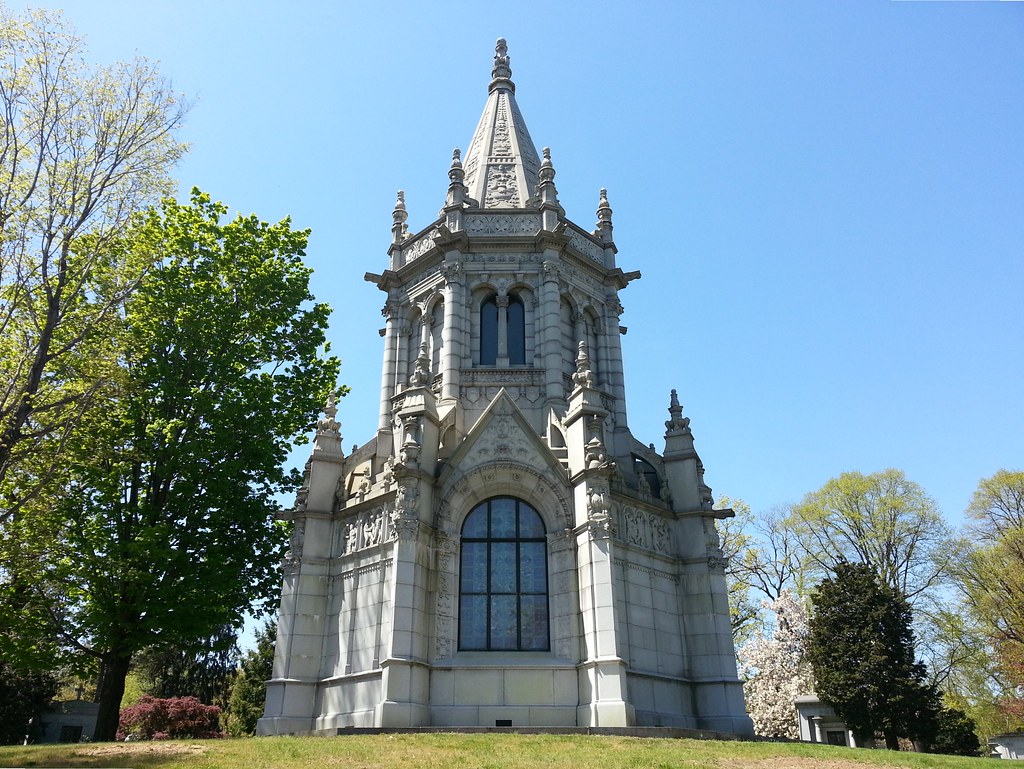
After the wealthy stockbroker John H. Harbeck died at the Plaza Hotel after a short illness in 1910, his wife, Kate, set about to build the most expensive and impressive mausoleum at Woodlawn Cemetery. The architect Thomas E. Blake designed a 90-foot-tall marble octagon with a steeple, heavy bronze doors, Tiffany windows and a pipe organ. The mausoleum was built by Guastavino in 1918. Kate was buried in the mausoleum in 1930 after dying in freakish revolving door accident on New Year's Eve at the Plaza Hotel.A few other miscellaneous items:
• John and Kate were apparently doting pet owners who were ridiculed by their neighbors in Boulder, Colorado (where they had a summer home) for "holding expensive and elaborate funerals" for their dogs.
• After meeting Kate, John went through some messy divorce proceedings with his wife, Caroline, that centered around determining whether Caroline was, in fact, his wife, legally speaking. The NY Times covered the trial pretty heavily, but also evinced some disdain for those captivated by the scandalous affair: "A great number of persons with nothing else to do crowded the court-room . . . yesterday morning, and many more stood in a line for hours waiting for an opportunity to enter".
• In researching the Harbecks, I stumbled upon yet another example of how much better journalism was a hundred years ago. From a 1906 report in the NY Times: "LOST — A CEMENT BARREL. It Had a High Old Time Before It Invaded the Subway". The piece goes on to offer the reader some sage, hard-earned words of wisdom: "an old barrel that is out for a good time and does not care a hoop, any way, is a difficult thing to tackle in a stiff breeze."
• While we're on the subject, you should also read this great NY Times article from 1882 that I discovered a few weeks ago:
Some Italian lunatic residing in Turin has for months past been indulging in the monomania of writing and sending enormous quantities of letters to persons residing in this City . . . The recipients, regarding the matter as an oversight on the part of some foreign or traveling friend, pay the postage and open the letters only to find them filled with balderdash and senseless twaddle in Italian, with a faulty English translation appended, the nonsense being usually addressed "to the noble and illustrious reader," and the writer subscribing himself as "The Emperor of the World, Monarch of the Universe," &c.
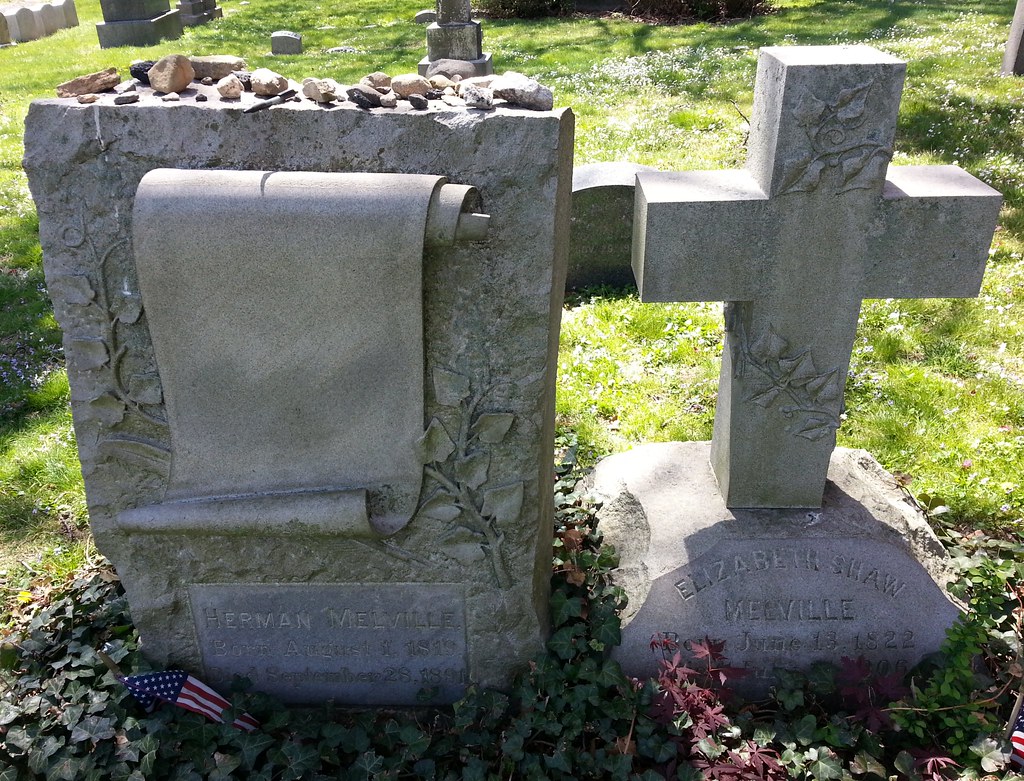
On previous visits to Mr. Melville's grave, I've found much more colorful and appropriate tokens left on his tombstone, including a profusion of pens and a canister of La Baleine Sea Salt. (The one pen in the photo above is mine.)

The eponymous founder of the prestigious prizes for excellence in American journalism was also the father of yellow journalism, making him the grandfather, I guess, of the NY Post and the Daily News and the rest of today's trashy tabloid rags.
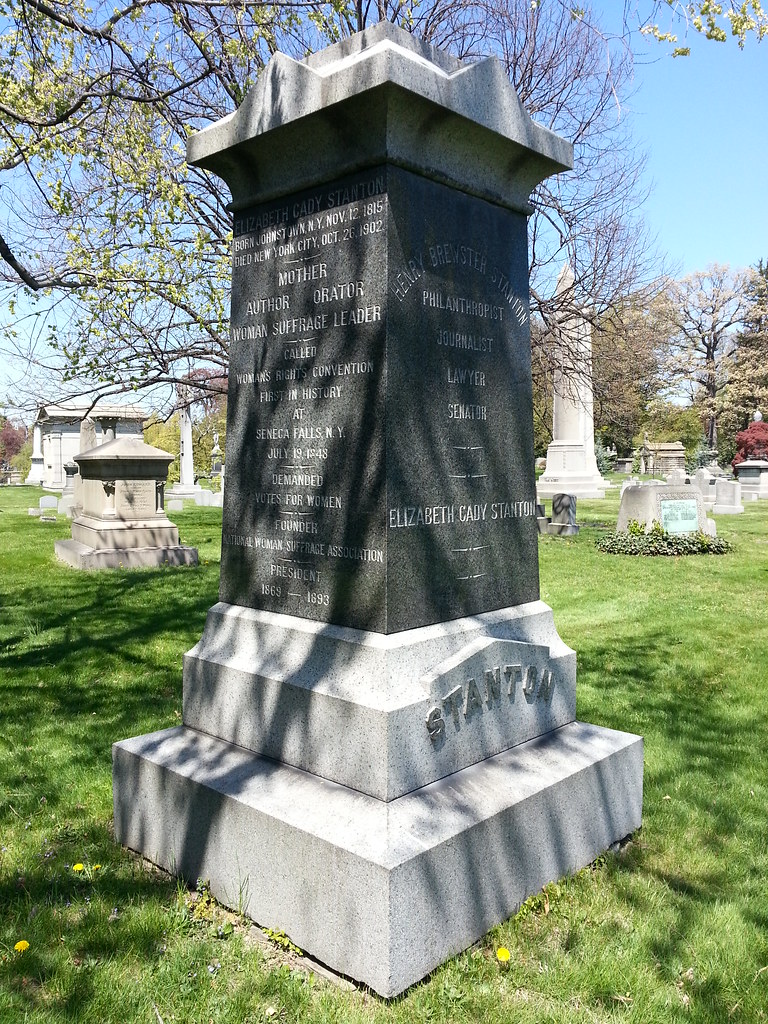
19th-century pioneer of the women's rights movement.
I didn't know it at the time, but not too far away is the grave of George Spencer Millet, who died a bizarre and tragic death on February 15, 1909, the day he turned 15 years old. According to his headstone:
LOST LIFE BY STAB IN FALLING ON
INK ERASER, EVADING SIX YOUNG
WOMEN TRYING TO GIVE HIM
BIRTHDAY KISSES IN OFFICE
METROPOLITAN LIFE BUILDING
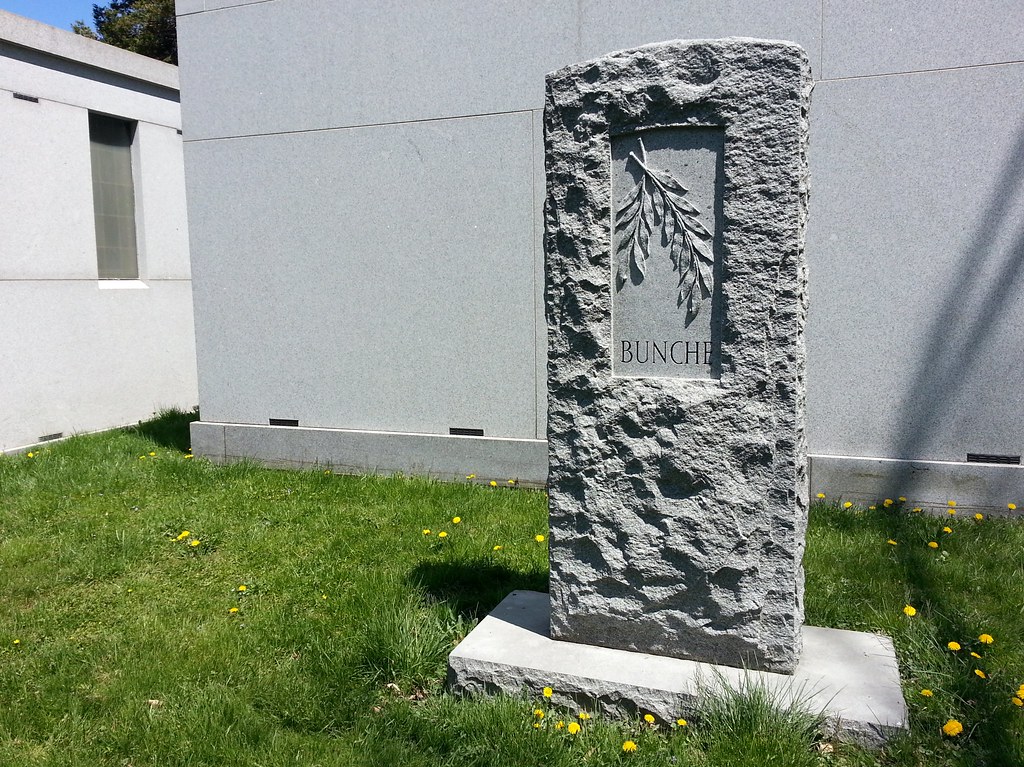
Olive branches are a fitting symbol for the life of this longtime UN diplomat who became, in 1950, the first African-American winner of the Nobel Peace Prize.
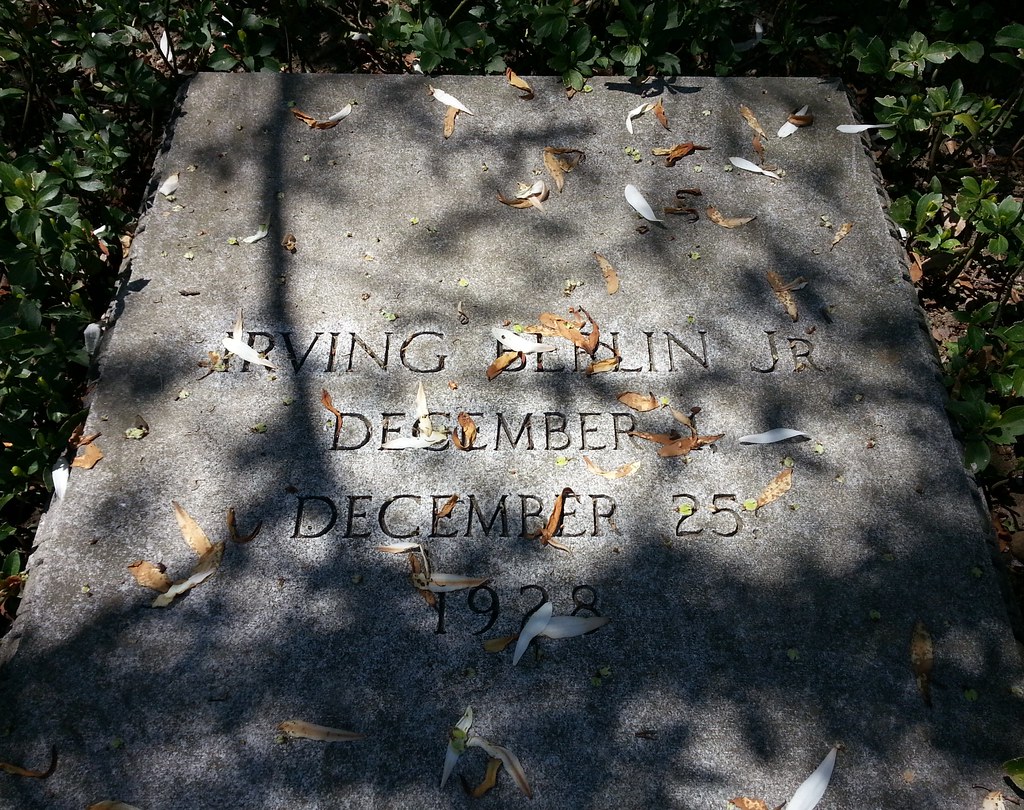




This is what Jerome Kern had to say about the Jewish composer of "White Christmas", the best-selling recording of all time, who cranked out an endless stream of hits over the decades: "Irving Berlin has no place in American music. He is American music."
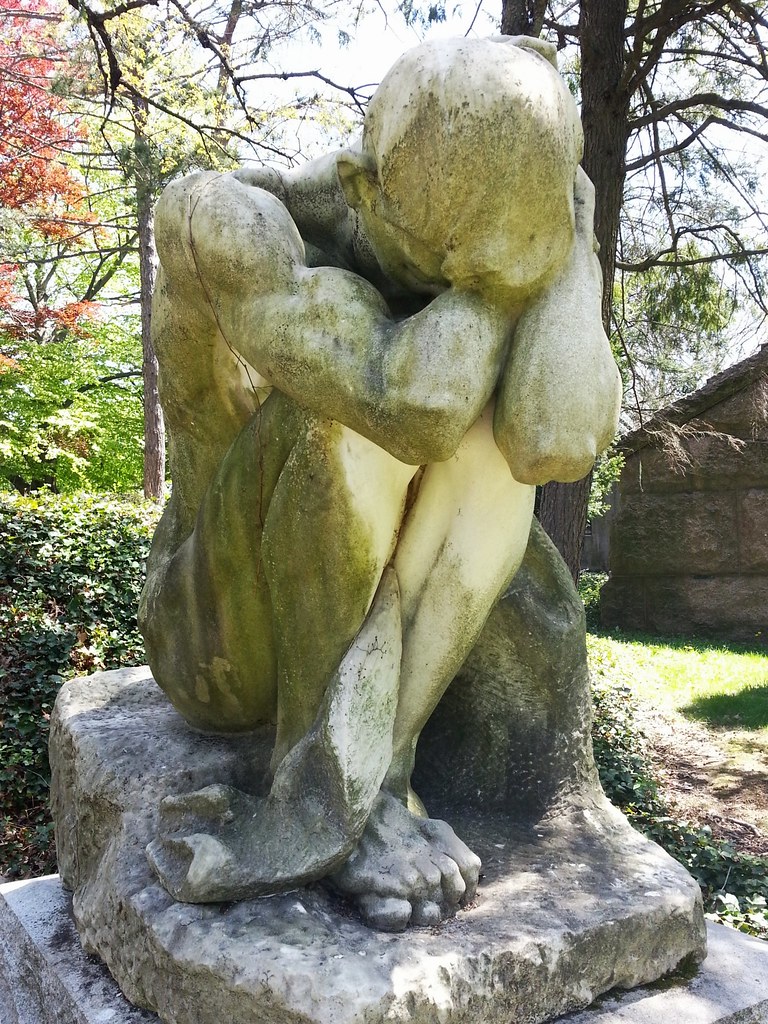
IN MEMORY OF
OUR ONLY BELOVED SON
ENSIGN NATHAN Q. F. PICCIRILLI
WHO MADE THE SUPREME SACRIFICE
FOR HIS COUNTRY AT THE BATTLE
OF ORMAC BAY, PHILIPPINE ISLANDS
ON DECEMBER 7, 1944
(Sculpted by his uncle)
I'm walking every street in New York City.
This is the counterpoint to my walk across the US. Instead of seeing a million places for just a minute each, I'm going to spend a million minutes exploring just one place. By the time I finish walking every block of every street in all five boroughs, I'll have traveled more than 8,000 miles on foot — all within a single city. Details!
Email me at matt@imjustwalkin.com
Subscribe to my email list
Maps: Progress | Photos

~9,954 miles walked
Your donations allow me to keep walking full-time. If you think what I'm doing is valuable and you'd like to offer some support, I would be very grateful. On the other hand, if you think I'm a worthless bum, feel free to email me and tell me to get a job, bozo. Both are excellent options!
