

That shiny space pod is part of the Sedgwick Branch of the New York Public Library.

This community center occupies the former home of the Hebrew Institute of University Heights.


That's the Gould Memorial Library flanked by the Hall of Languages (on the left) and the Hall of Philosophy.
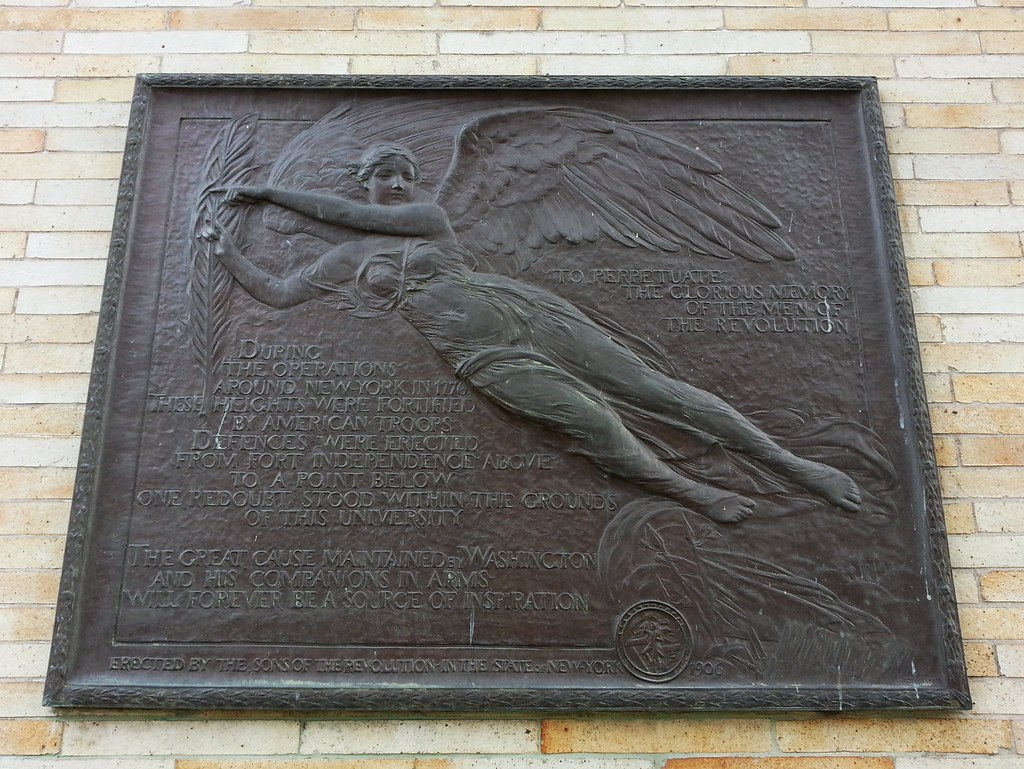
This plaque casually neglects to mention that the aforesaid redoubt was occupied, for almost the entire duration of the war, by a garrison of British troops who used its strategic location to rain fire down upon the Americans.
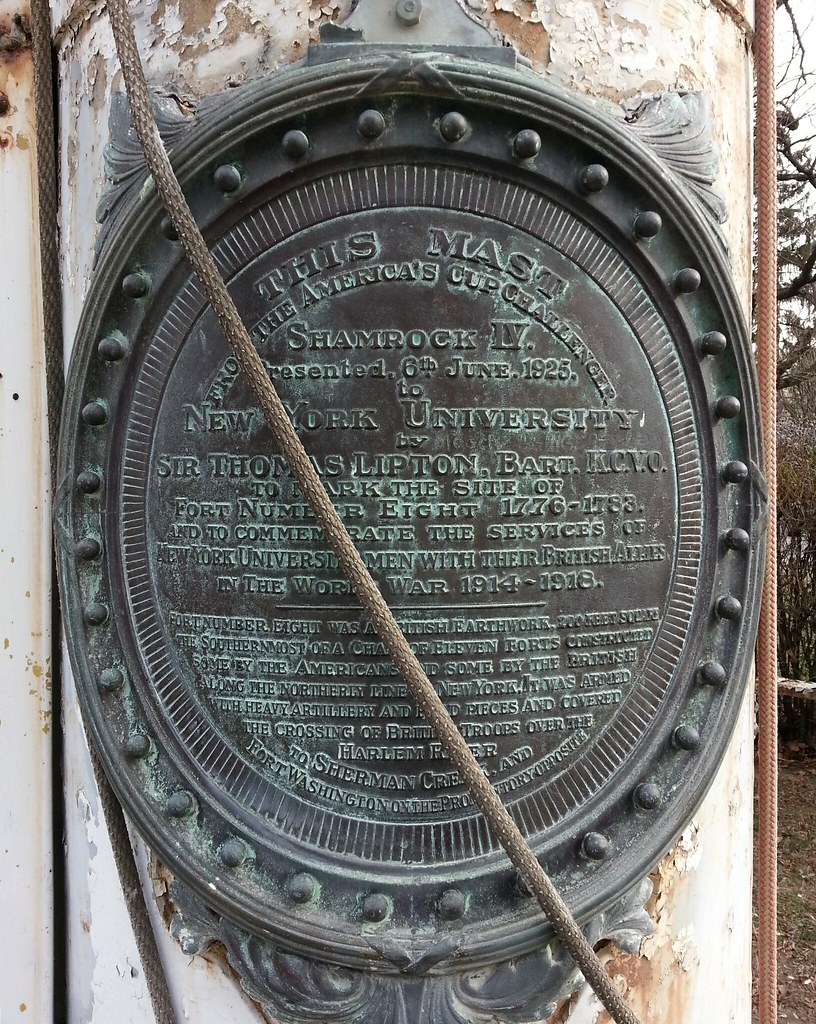
Standing near the guns mentioned in the previous post is this mast from Shamrock IV, the unsuccessful British challenger in the 1920 America's Cup held in and around Lower New York Bay.

Pointed at our favorite set of quadruplets (the leftmost is hidden behind another building) from its lofty perch atop a hill on the campus of Bronx Community College, this (World War I-era?) gun and a couple of others mark the site of Fort Number Eight, a British redoubt that stood on these heights during the Revolutionary War.

I once spotted this fortress-like structure from a couple of miles away; not realizing it lay within the bounds of Bronx Community College and never suspecting it could be an academic building, I assumed it was some kind of telecom facility. "The main facade is relatively conventional, if recognizably Breuer, but the southern side has eight windowless floors — seven in blinding white concrete — set on a featureless base. It’s neoclassical austerity on a modernist scale."
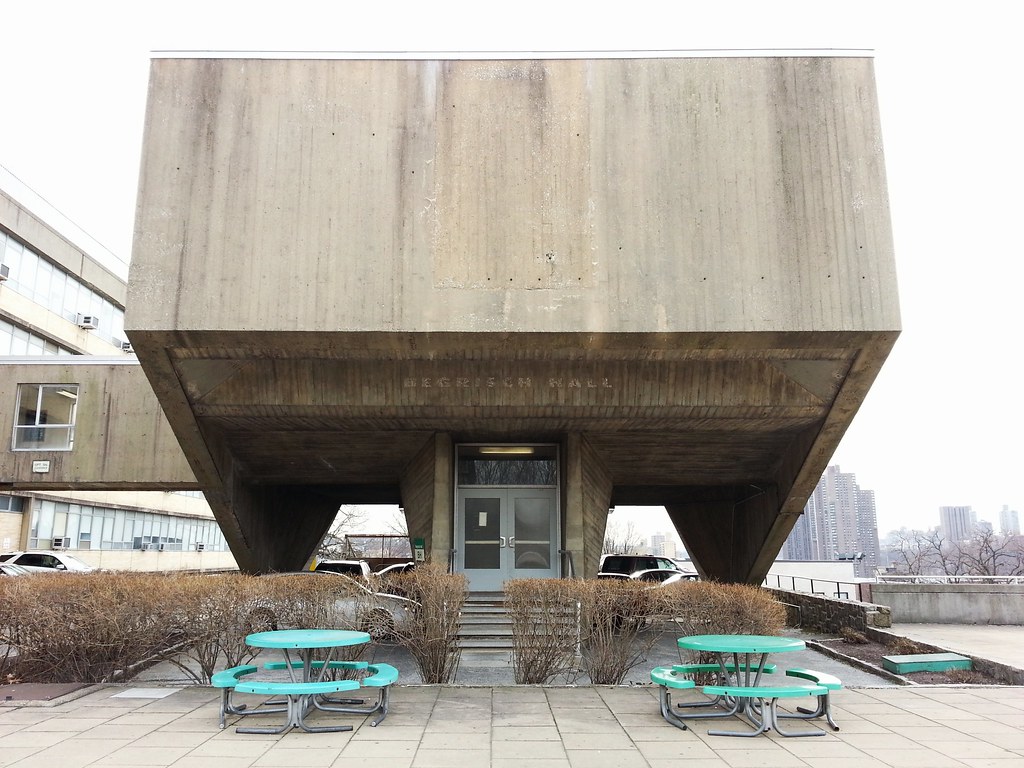
Another one of Breuer's Brutalist creations, Begrisch Hall "is a wedge of concrete balanced on its skinniest edge . . . It looks as if it could be tipped over in a prank." Here's a view from behind.

From left to right, we have the Hall of Languages, the colonnaded Hall of Fame walkway, and the Gould Memorial Library, all designed by famed architect and champion moustache wearer Stanford White (whose scandalous 1906 murder resulted in the first so-called "trial of the century"*) and built around the turn of the 20th century as part of the original quadrangle of New York University's uptown University Heights campus (which is now Bronx Community College).
Providing a stark contrast to White's neo-Classical works, Marcel Breuer added five new Brutalist structures to the grounds in the 1960s, including Community Hall, which is serving as the mirror in this photograph. (The "Colston Hall" label on that green-and-white sign to the right refers to the much larger building standing behind this one; the two are linked by a pair of concrete sky bridges).
* What made it the trial of the century? The journalist Irvin S. Cobb put it this way:
"You see, it had in it wealth, degeneracy, rich old wasters, delectable young chorus girls and adolescent artists' models; the behind-the-scenes of Theatredom and the Underworld, and the Great White Way. . . . the abnormal pastimes and weird orgies of overly aesthetic artists and jaded debauchees. In the cast of the motley show were Bowery toughs, Harlem gangsters, Tenderloin panderers, Broadway leading men, Fifth Avenue clubmen, Wall Street manipulators, uptown voluptuaries and downtown thugs."
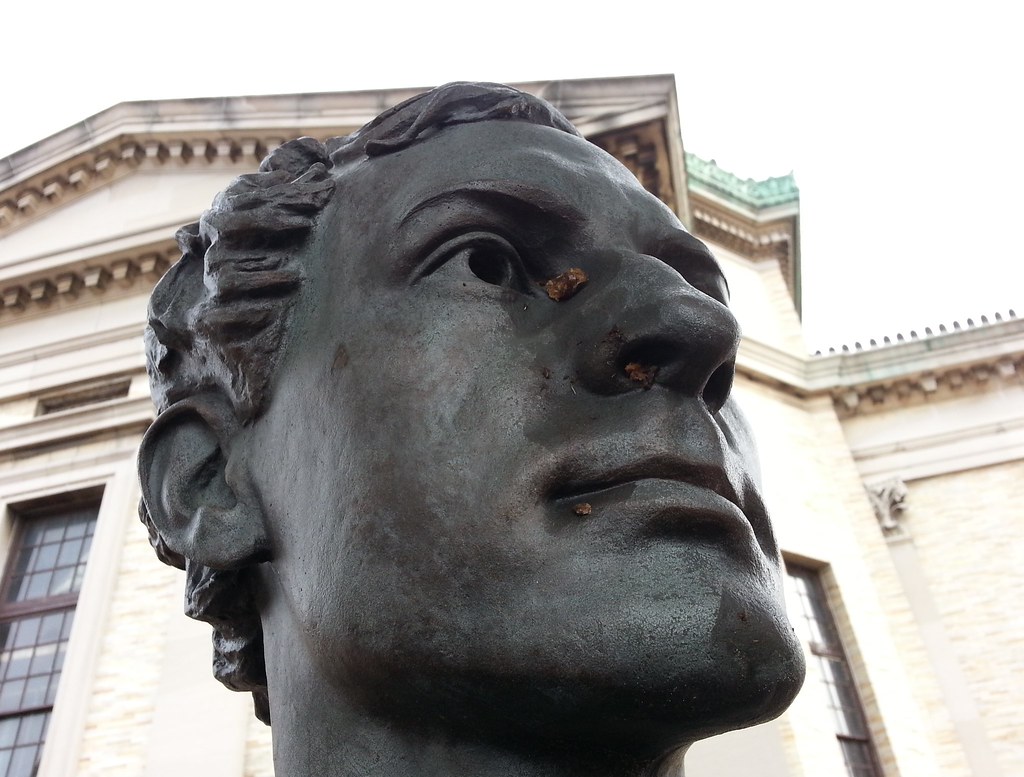
Not long before his brother shot Abraham Lincoln, this renowned 19th-century actor saved the president's son, Robert, from being seriously injured or killed when he fell between a moving train and the platform at a station in Jersey City.
No, I don't know what's on his face either.

Curving around the back half of the Gould Memorial Library, it's America's first hall of fame! That's Mr. Dime in the lower right, FYI.
Hey, somebody else showed up! (He's talking on the phone, in case you can't tell.)


I'm walking every street in New York City.
This is the counterpoint to my walk across the US. Instead of seeing a million places for just a minute each, I'm going to spend a million minutes exploring just one place. By the time I finish walking every block of every street in all five boroughs, I'll have traveled more than 8,000 miles on foot — all within a single city. Details!
Email me at matt@imjustwalkin.com
Subscribe to my email list
Maps: Progress | Photos

~9,954 miles walked
Your donations allow me to keep walking full-time. If you think what I'm doing is valuable and you'd like to offer some support, I would be very grateful. On the other hand, if you think I'm a worthless bum, feel free to email me and tell me to get a job, bozo. Both are excellent options!
