
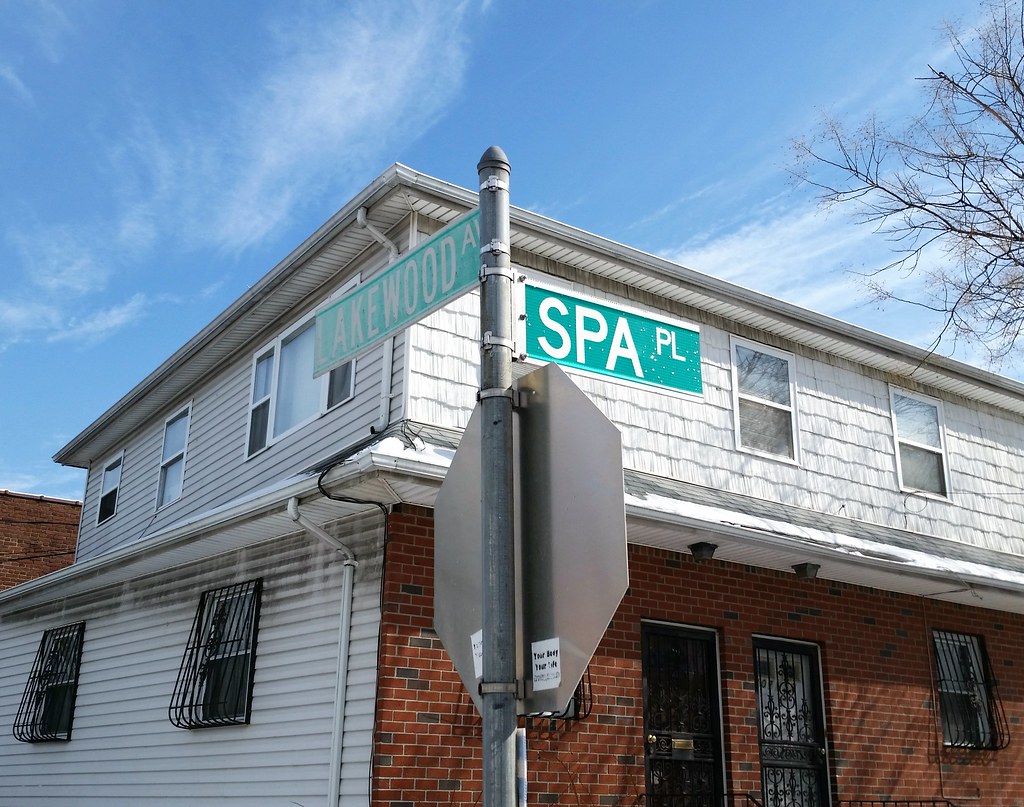
I was hoping to figure out the meaning behind the name of this little two-block-long street, but all I was able to find out is that the street had become Spa Place by 1919, having formerly been known as Kouwenhouven Place.
While digging in vain through old newspaper archives for that information, I was surprised to see Spa Place mentioned a couple of hundred times, given that there are only eight houses on the street (with Spa Place addresses). Many of the mentions were for everyday things — real estate transactions, rental listings, wedding announcements, etc. A number had to do with crimes committed on the street or by people who lived there. Some examples:
- "Being intoxicated is no excuse for thievery," two young men learned when they were found guilty of petty larceny after showing up uninvited to a party at 108-05 Spa Place on New Year's morning of 1933, "joining in the hilarity," and then stealing a couple of coats and hats on the way out.
- In 1928, John J. Reardon, a bus driver who lived at 107-something Spa Place, was charged with third-degree assault for punching a female passenger in the jaw after she slapped him during an argument over a disputed fare.
- In 1937, at the age of 17, William Kotowski/Kotowsky/Kapowski (the Long Island Daily Press wasn't too consistent with its spellings) of 107-62 Spa Place was sent to a vocational institute after being charged with stealing some vacuum cleaners and "criminally receiving" a stolen car. Then, in 1941, he was convicted on a "morals charge" and sentenced to a reformatory for striking a girl who "resisted his advances."
- "A speeding truck driver [Theodore Kotski of 108-04 Spa Place], who refused to back up 500 yards so he could be arrested by a Queens motorcycle cop who had trailed him over the Nassau County line, nevertheless wound up in court here yesterday [July 6, 1952] charged with hampering an officer in the discharge of his duty."
The largest contingent of Spa Place mentions in old newspapers, however, is found between 1930 and 1935 in the Junior Press section of the Long Island Daily Press, where local kids would submit jokes, stories, poems, drawings, and the like (some original, many obviously not) for publication. A few children on Spa Place were members of the Junior Press Club, including Jessie Kotowska of 107-62 Spa Place, presumably the sister of the aforementioned William Kotowski/Kotowsky/Kapowski (again, the Long Island Daily Press wasn't very consistent with its spellings), but the bulk of the Spa Place contributions to the Junior Press came from the Szczesny/Szczesna/Szczensy/Szezesny/Szszesny/Szszesna/Szizesny/Scezesny/Szzesna sisters of 108-09 Spa Place. Some favorites:
Jones: "Sorry, old man, that my hen got loose and scratched up your garden."
Smith: "That's all right. My dog ate your hen."
Jones: "Fine! I just ran over your dog!"
Sent by Henrietta Szczesny, 108-09 Spa Place
Program Manager—"If you're late again like this, you don't have to bother showing up."
Tardy Artist—"Well, you see, it was like this: I squeezed too much toothpaste onto my brush and I had a hard time getting it back into the tube."
Sent by Henrietta Szczesna, 108-09 Spa Place
Two Irishmen stood in front of a drug store. In the window there was a display of rubber gloves.
"Now, I wonder what those things are for?" asked one of the Irishmen.
"Oh," replied the other Irishman, "You can put them on an' wash your hands without getting your hands wet."
Sent by Jane Szczesny, 108-09 Spa Place
TONGUE TWISTERS
Sister Susie's silly sister said to Sissy Simpkins, "Say, Sister Susie's suitor Simpson soundly sips soup, sitting with Sister Susie."
Seven small saps swam to school in sixty-six short, silent seconds hoping to see Sarah Samson slapping Samuel Stanley, Sally's sporty schoolmate.
Sent by Jane Szczesna, 108-09 Spa Place
GOOD OLD DOBBINS
O, Horse, you are a wonderful steed,
No buttons to push, no gas to feed;
You start yourself, no clutch to rip,
No spark to miss, no gears to strip;
No license buying every year,
With plates to screw on front and rear;
No gas bills climbing up each day,
Repairs don't steal your cash away;
No speed cops chugging in your rear,
Yelling summons in your ear;
Your inner tubes are all O. K.,
And, thank the Lord, they stay that way;
Your spark plugs never miss or fuss;
Your motor never makes us cuss;
Your frame is good for many a mile,
Your body never changes a style;
Your wants are few and easy met,
You've something on the auto yet.
Sent by Jane Szzesna, 108-09 Spa Place
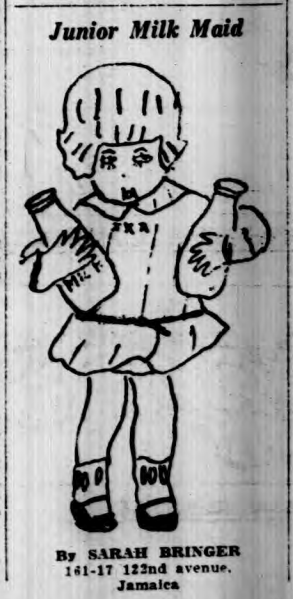
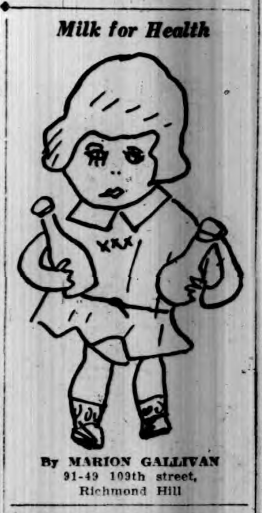
On a final note, while flipping through the pages of the Junior Press from August 23, 1930 and August 30, 1930, I saw two different but very similar (and slightly creepy-looking) drawings of a young girl holding a couple of milk bottles. Do these look familiar to anyone? Was this a character from some old milk ads?
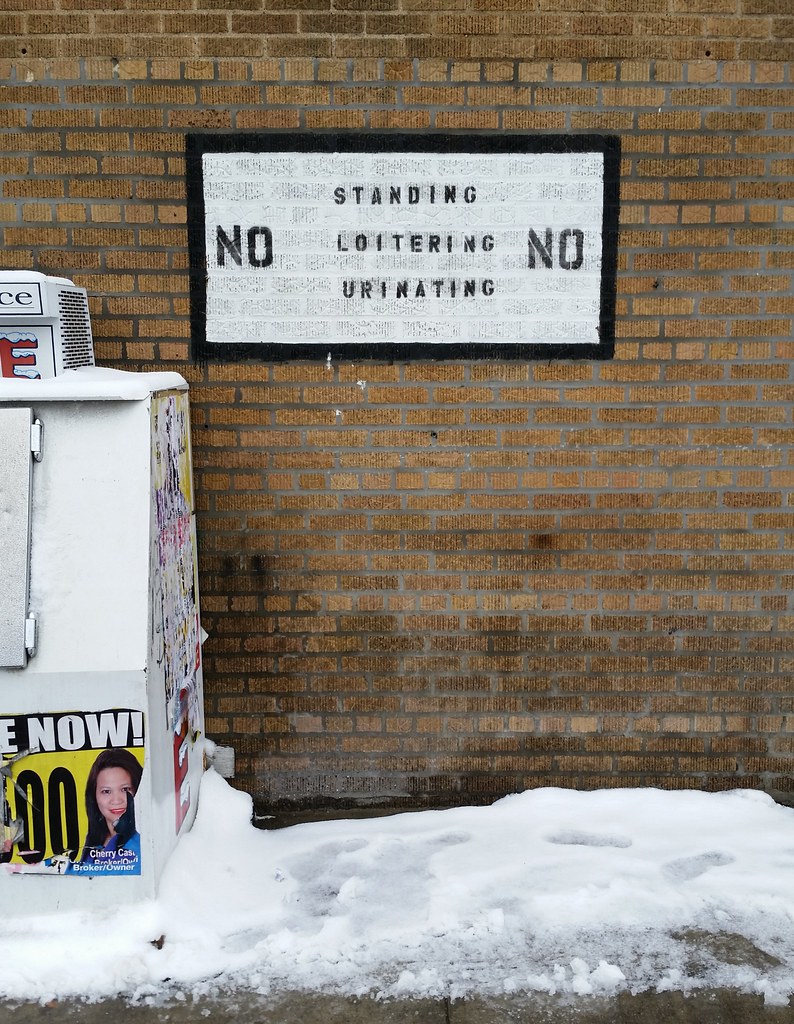

This "fading gem", built in 1908, "stands out with its intricate facade and rose trim, [but] the toll of years of neglect are apparent."
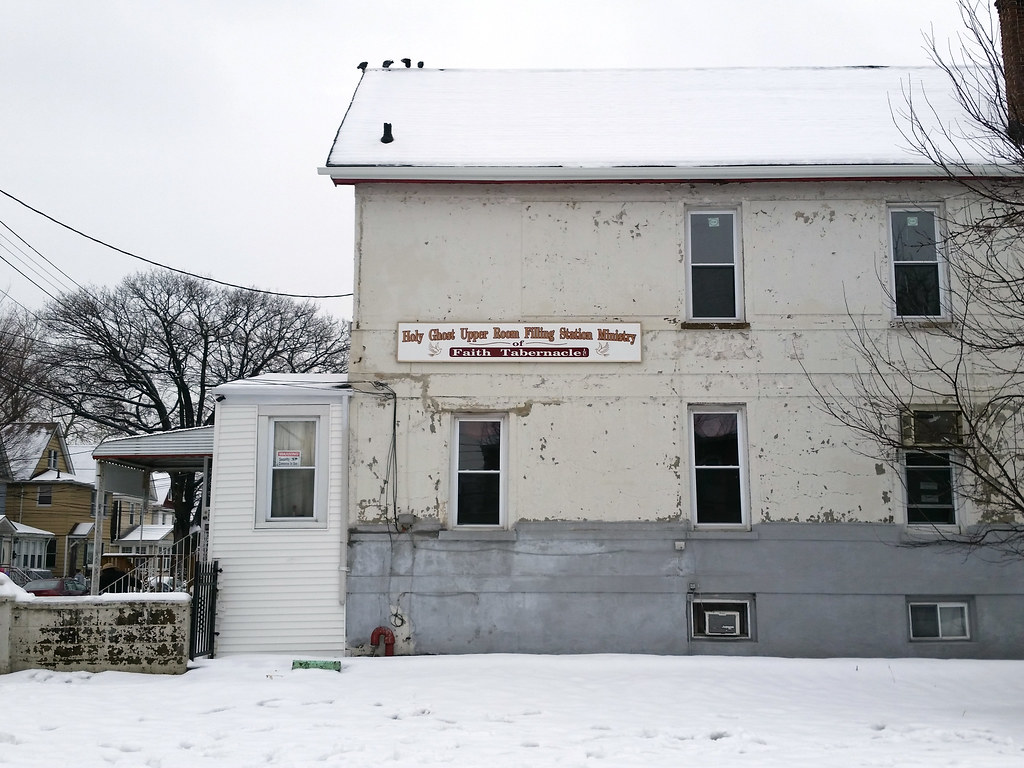
Holy Ghost Upper Room Filling Station is a church/food pantry started by Doris Johnson in her home in 2004. It appears to have recently relocated to the old Faith Tabernacle Church.
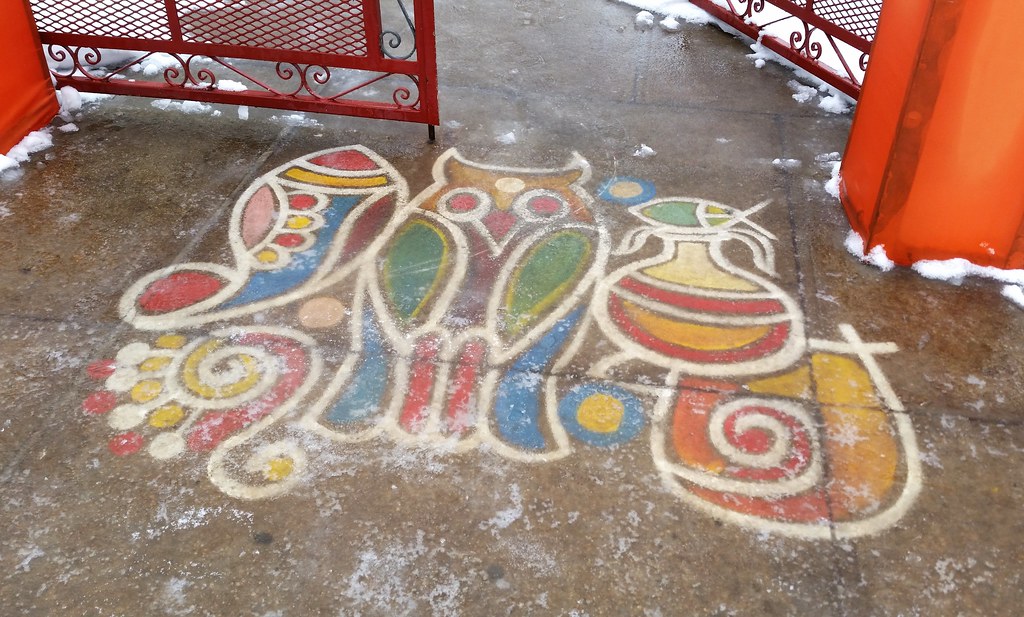
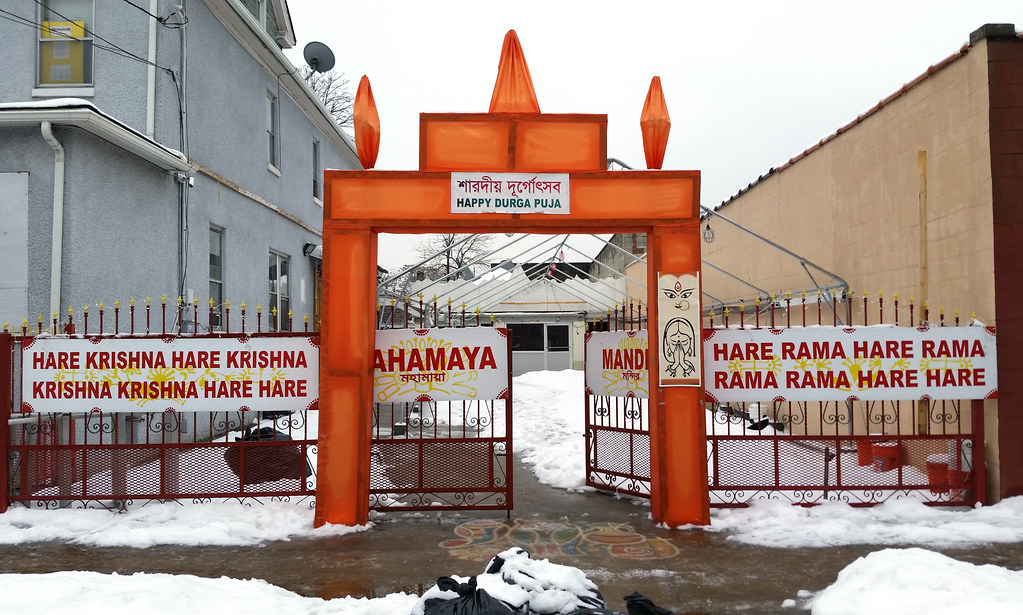
Happy (belated) Durga Puja from your friends at Mahamaya Mandir.
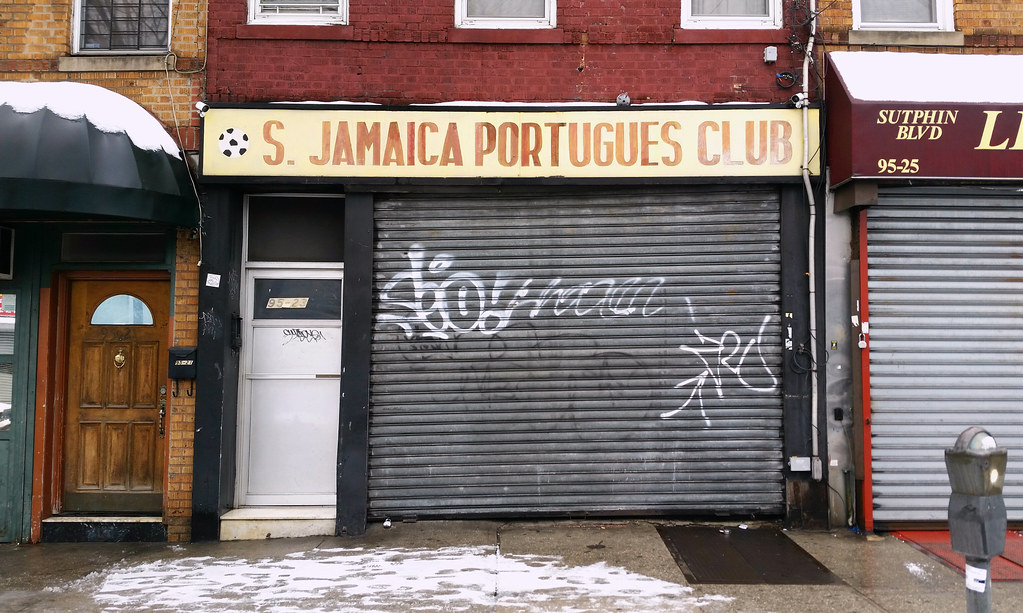
On a walk through Jamaica in early 2012, I was surprised to discover that there's something of a Little Portugal (or perhaps a Little Little Portugal) out here. I saw a liquor store specializing in Portuguese wines and, two doors down, a Portuguese restaurant named O Lavrador that's been around since 1981. Now, three years later and seven blocks away, I've finally walked by the other mini-hub of Little Little Portugal: the soccer club pictured above and, just out of frame to the right, another longstanding Portuguese restaurant, A Churrasqueira.

Spotted in Long Island City on my way out to Jamaica

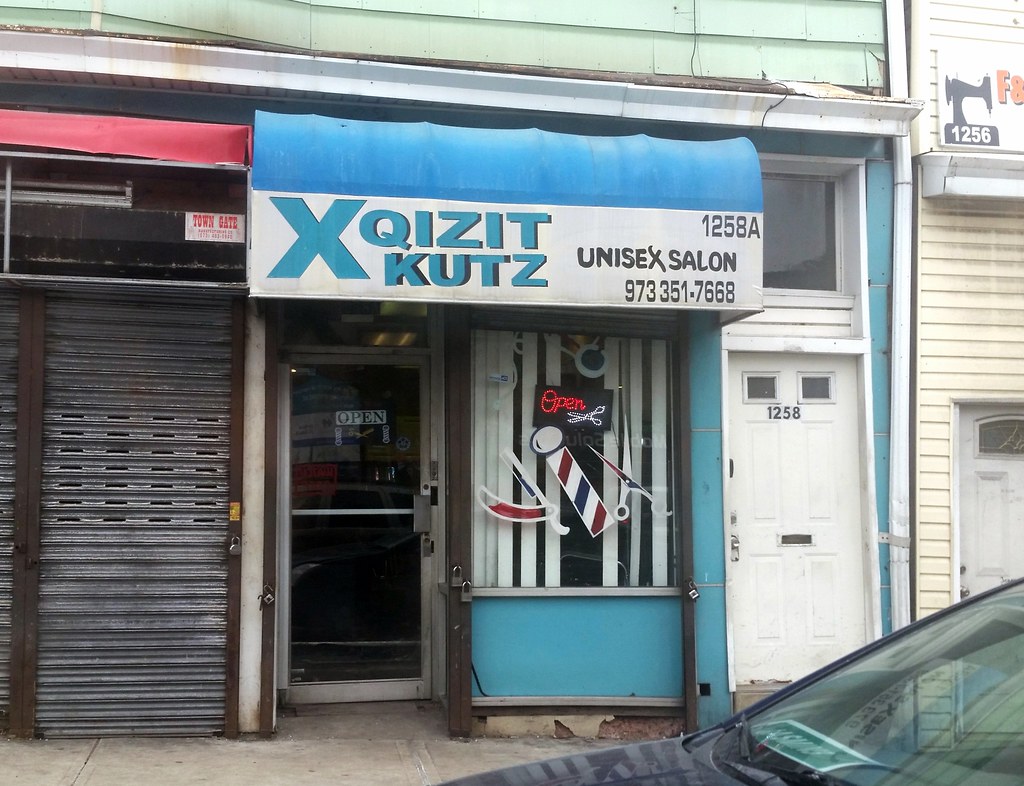
I was riding in a car on Springfield Avenue in Irvington, New Jersey, when I glanced out the window and spotted the ne plus ultra of barberz: XQIZIT KUTZ. For those keeping count, we have, in the space of a mere ten characters: 1) an E-less X, 2) a U-less Q, 3) a Z in place of an S, 4) an excised silent E, 5) a K in place of a C, and 6) another Z in place of an S. Astounding!
Now, you could potentially argue that an I (or two) should have been swapped out for a Y, or that the first T should have been turned into a D, but, come on, XQIZIT KUTZ is too restrained for that kind of nonsense.
Since it's not located in NYC, this xqizit xample of the barbering artz won't make it onto the official list of barberz, but that's just as well. It's clearly in a class of itz own.
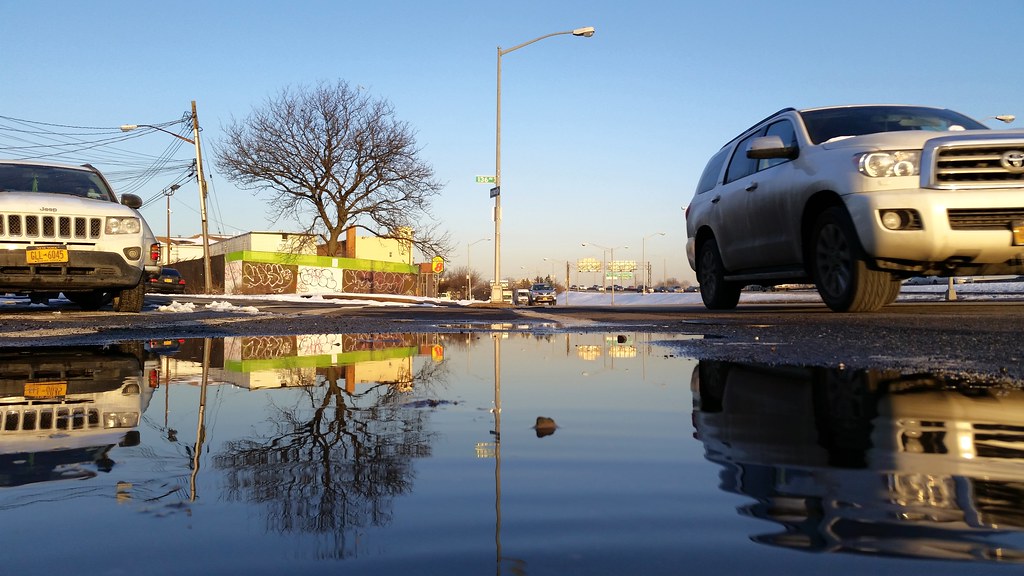
The road at right, on which the Toyota SUV is traveling, is Conduit Avenue, named for the conduits that used to carry Brooklyn's drinking water westward to the Ridgewood Reservoir along the route that the road now follows.
The original plan for Brooklyn's water supply system called for the eastern portion of the aqueduct connecting the various water sources to be an open canal rather than an enclosed conduit. It would have initially been cheaper to go with a canal, but those savings would have been outweighed by a number of problems — dead animals tossed into the canal by disgruntled countryfolk, for instance — as pointed out by an 1858 letter to the editor of the NY Times, partially reproduced here:
With such an exposed surface, so wide-mouthed a ditch, continuing so long a distance, the water will be subjected to quantities of filth, partly intentional, partly unintentional. The country people along the line are, from one cause and another, bitterly opposed to the canal, part of the Water Works project, and as it passes through such a frequented part of the island, the thought of what would be cast into it, (dead animals, for instance,) arouses anything but pleasant feelings. Trouble would arise also from quantities of drift sand, leaves, &c.; and, in Winter, (the grade being two-tenths of a foot only to the mile,) the water would freeze, or half-freeze, and the flow would be, at times, altogether impeded. . . .
On all sides, too, it is conceded, that if the canal is adhered to, it will unquestionably have to be changed to a masonry conduit within a short time. That odor of dead cats and decaying dogs will stick to the whole work, and cast ridicule upon it until the change is made.
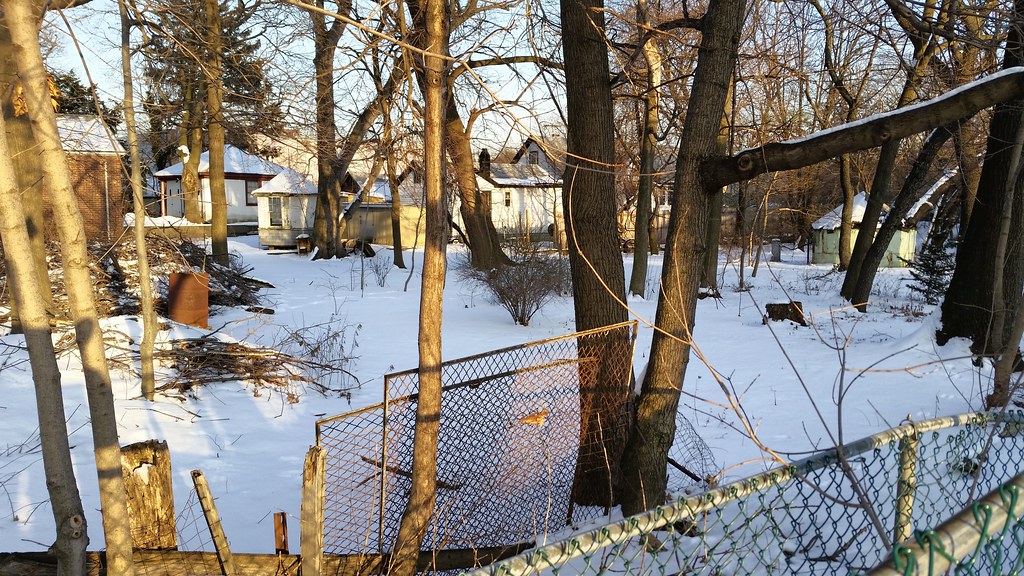
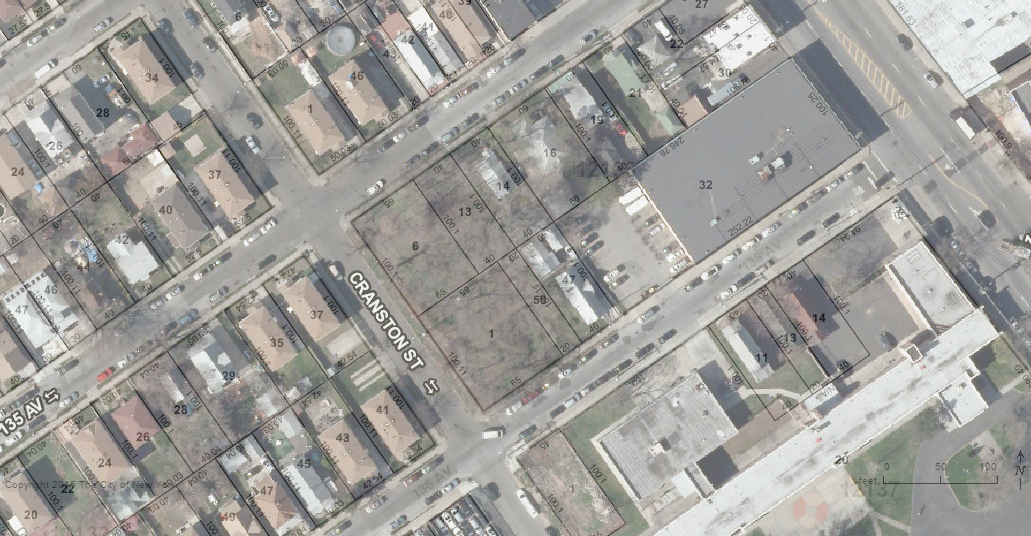
The odd little building at right, a cylinder with a rotting conical roof (closer look), stands alone on a half-acre of vacant, treed land in the midst of an otherwise pretty heavily developed neighborhood (aerial view). According to city records, the largest three of the four lots that constitute the vacant land have been owned for more than three decades by the same people — Beverly Dietrich and Andrew Lundy — who own the brick house at far left and the funky hexagonal shack (closer look) that stands behind it. (They own the house next door to that one as well. Compare the yards of those two houses to those of their neighbors.) It all makes for a somewhat perplexing sight, accented by a garbage bin stationed on the sidewalk outside the vacant lots, filled with what appears to be mostly household trash, accompanied by a sign that reads:
NYC SANITATION DEPARTMENT
DOES NOT PICK UP HERE
THE PROPERTY OWNER MUST
DISPOSE OF YOUR GARBAGE
PLEASE DO NOT LEAVE
HOUSEHOLD TRASH HERE
THANK YOU FOR YOUR COOPERATION
I'm walking every street in New York City.
This is the counterpoint to my walk across the US. Instead of seeing a million places for just a minute each, I'm going to spend a million minutes exploring just one place. By the time I finish walking every block of every street in all five boroughs, I'll have traveled more than 8,000 miles on foot — all within a single city. Details!
Email me at matt@imjustwalkin.com
Subscribe to my email list
Maps: Progress | Photos

~9,954 miles walked
Your donations allow me to keep walking full-time. If you think what I'm doing is valuable and you'd like to offer some support, I would be very grateful. On the other hand, if you think I'm a worthless bum, feel free to email me and tell me to get a job, bozo. Both are excellent options!
