
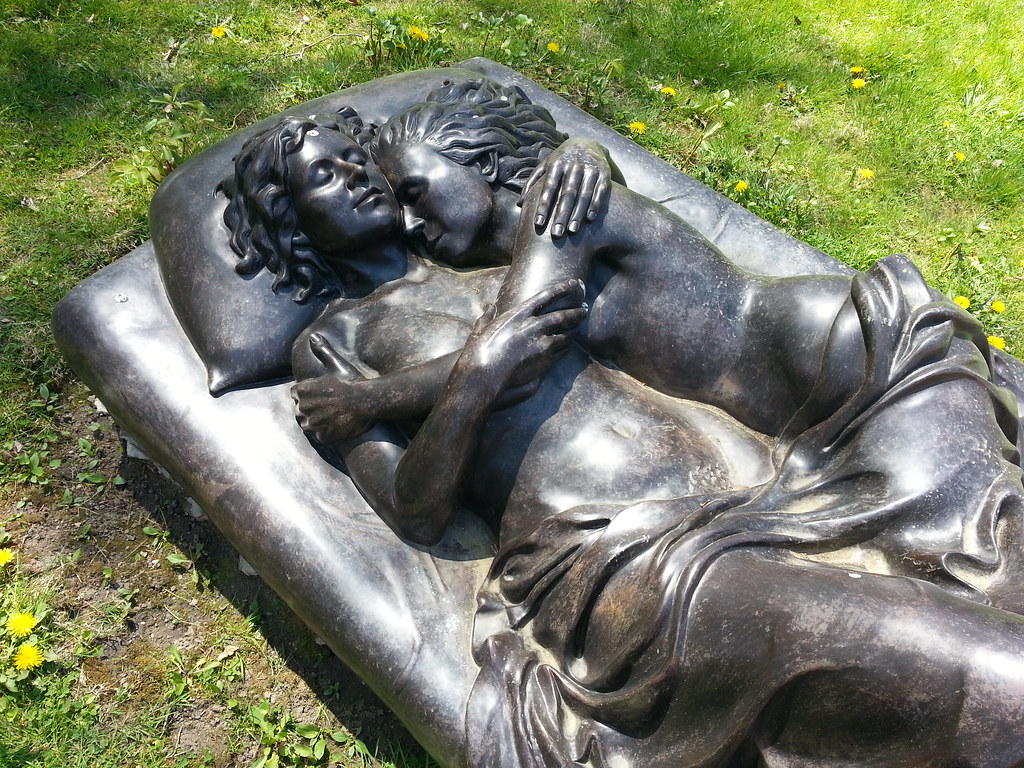

This sculpture by Patricia Cronin, depicting her and her wife, Deborah Kass, embracing in bed, will one day mark the couple's graves here at Woodlawn. When the original marble version of this work was installed in 2002, same-sex marriage was not legal anywhere in the United States. But less than nine years later, on a July day in 2011, Ms. Cronin and Ms. Kass found themselves tying the knot at the Marriage Bureau in Manhattan. "Making this was a little prophetic", said Ms. Cronin, referring to the memorial. "I never thought the law would change this quickly." (She replaced the marble monument with this bronze version a couple of months after the nuptials.)
You can see more photos of the sculpture here, and read an interview with the artist here.
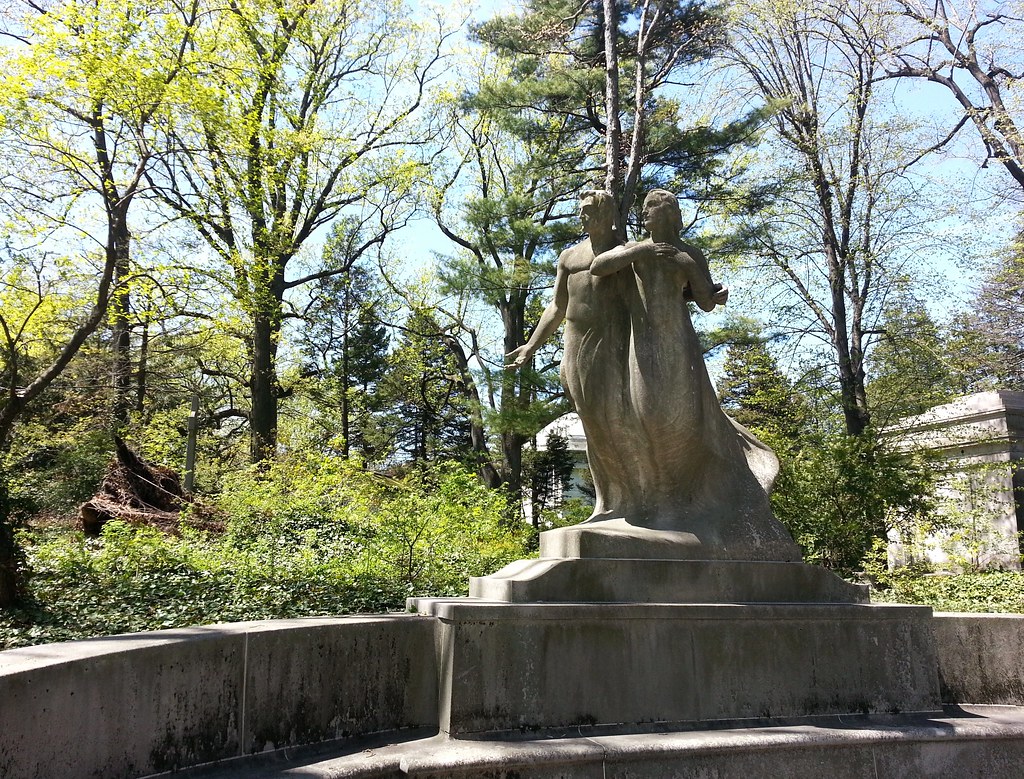
This unique monument was commissioned by William H. Bliss and his wife, Anna, sometime around 1913, a couple of decades before their deaths. An 1919 architectural review of the "William H. Bliss memorial" calls it "a significant contribution to the art of funereal commemorative monumental design" and says its "design gives evidence of thought and of a serious purpose and it establishes new precedents in this field of design."
If you search online, you'll find a multitude of sites referring to this monument as the "Annie Bliss Titanic Memorial" (or some variation thereof) and stating that Mrs. Bliss dedicated it to all those lost in the tragedy. While the monument does have a nautical theme — for instance, the Wordsworth line "Our souls have sight of that immortal sea which brought us hither" is carved into the exedra — and was designed just a year after the Titanic sank, I didn't see any text on it referencing the disaster (although I wasn't looking too closely at the time), and I can't find any mention of Mrs. Bliss's supposed dedication in the historical record.
Perhaps its location directly across from the Straus tomb (see previous post), combined with the fact that Woodlawn is said to have more "Titanic people" than any other cemetery in the US, has helped fuel this seemingly apocryphal claim. And it can't hurt that the two sculpted characters look like Jack and Rose from the movie Titanic — at least to the eyes of some younger cemetery visitors. (I also feel the need to note that the NY Times blog post to which I've now linked twice in this paragraph refers to Mrs. Bliss as an "heiress to a laxative fortune".)
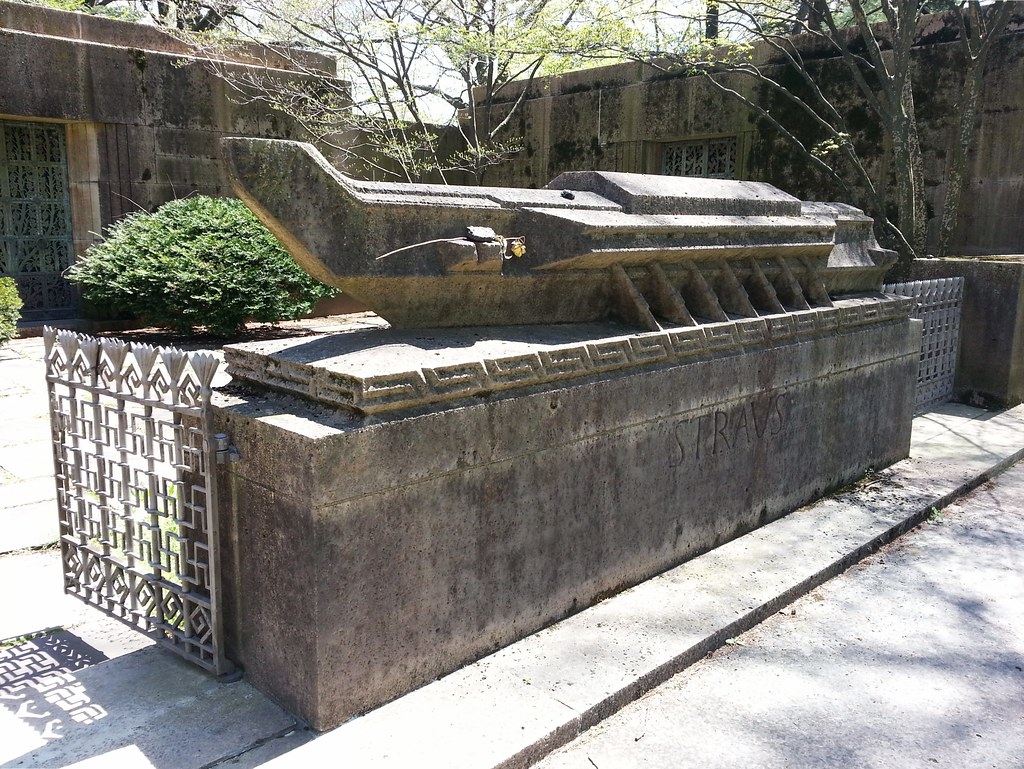
This is the tomb of Isidor Straus, a former congressman and co-owner of Macy's, and the cenotaph of his wife Ida. The couple died aboard the Titanic after Isidor passed up a lifeboat seat, seeing that there were still women and children on the ship, and Ida refused to leave his side. Isidor's body was later recovered, but Ida's was never found. The other side of the monument is inscribed with a line from the Song of Songs: "Many waters cannot quench love, neither can the floods drown it".
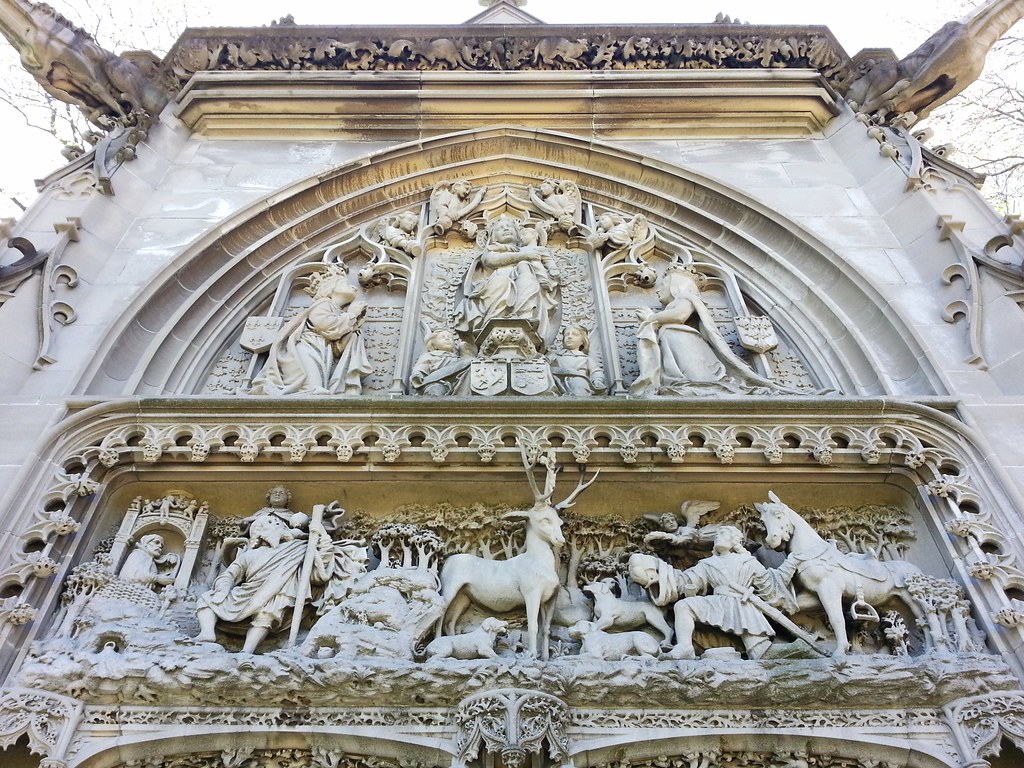
This replica of the Château d'Amboise's chapel of St. Hubert (where Leonardo da Vinci's remains are supposedly interred) is the final resting place of Alva and Oliver Belmont.
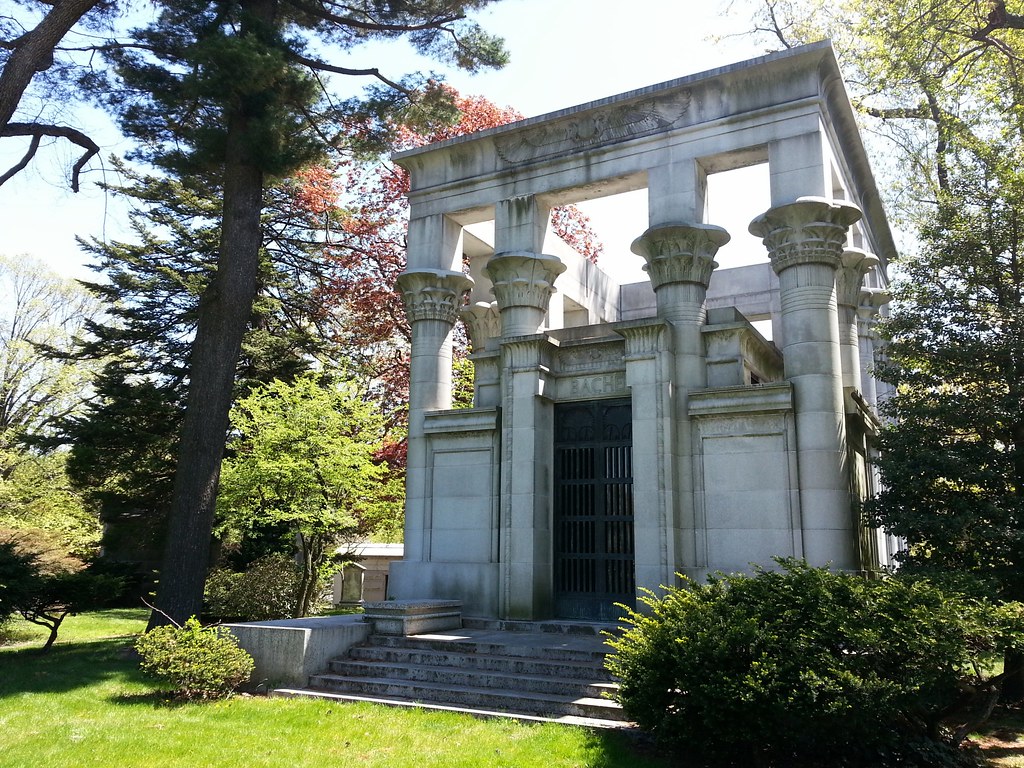
This prominent banker's remains are entombed inside a replica of Trajan's Kiosk.
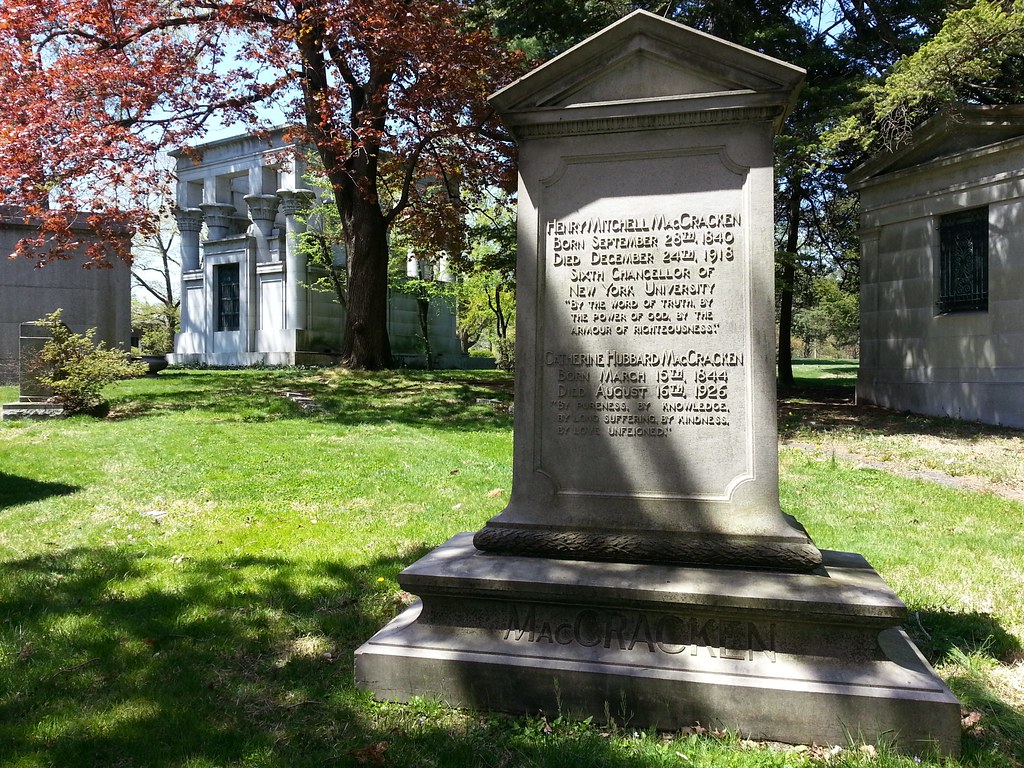
As chancellor of NYU, he was the driving force behind the creation of the Hall of Fame for Great Americans, now one of the city's most wonderful forgotten treasures. But far more importantly, he's the first character we've come across whose beard has a fighting chance of besting Peter Cooper's.
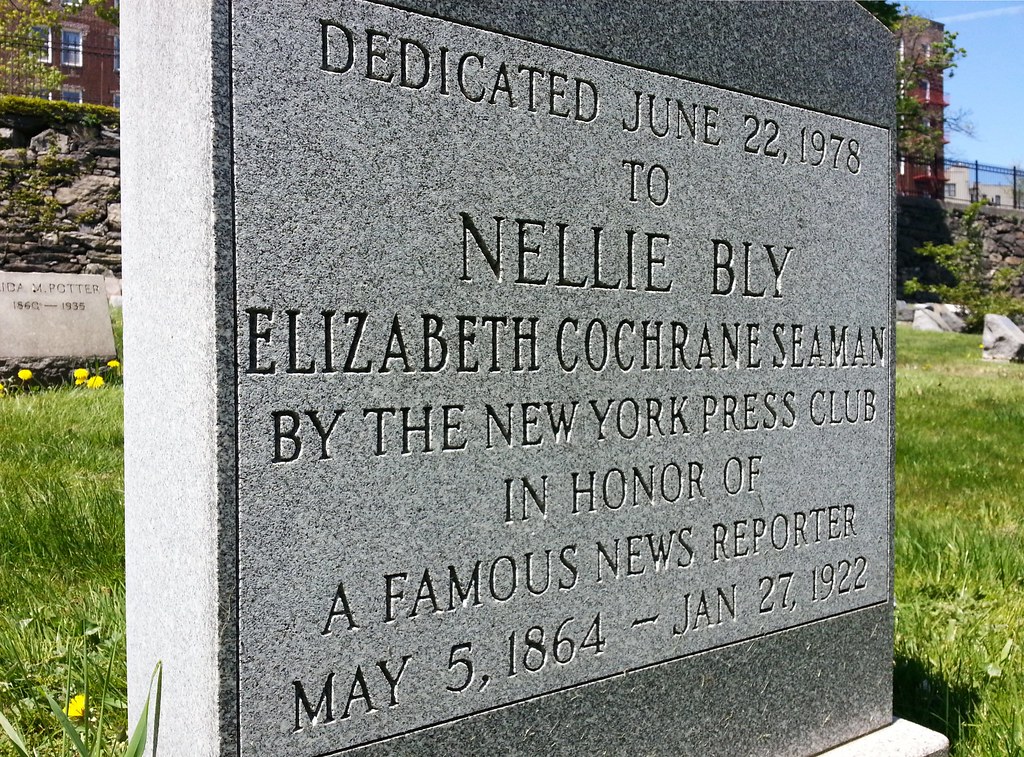
Nellie Bly "remains notable for two feats: a record-breaking trip around the world in emulation of Jules Verne's character Phileas Fogg, and an exposé in which she faked insanity to study a mental institution from within."

About this stone rest the remains of 417 among them early settlers and soldiers of the colonial and national wars, interred 1664-1908 in Nagel Cemetery, West 212th Street Manhattan, the site of which was covered by a vast public improvement [the 207th Street subway yard]. Reinterred here 1926-1927 by the City of New York.
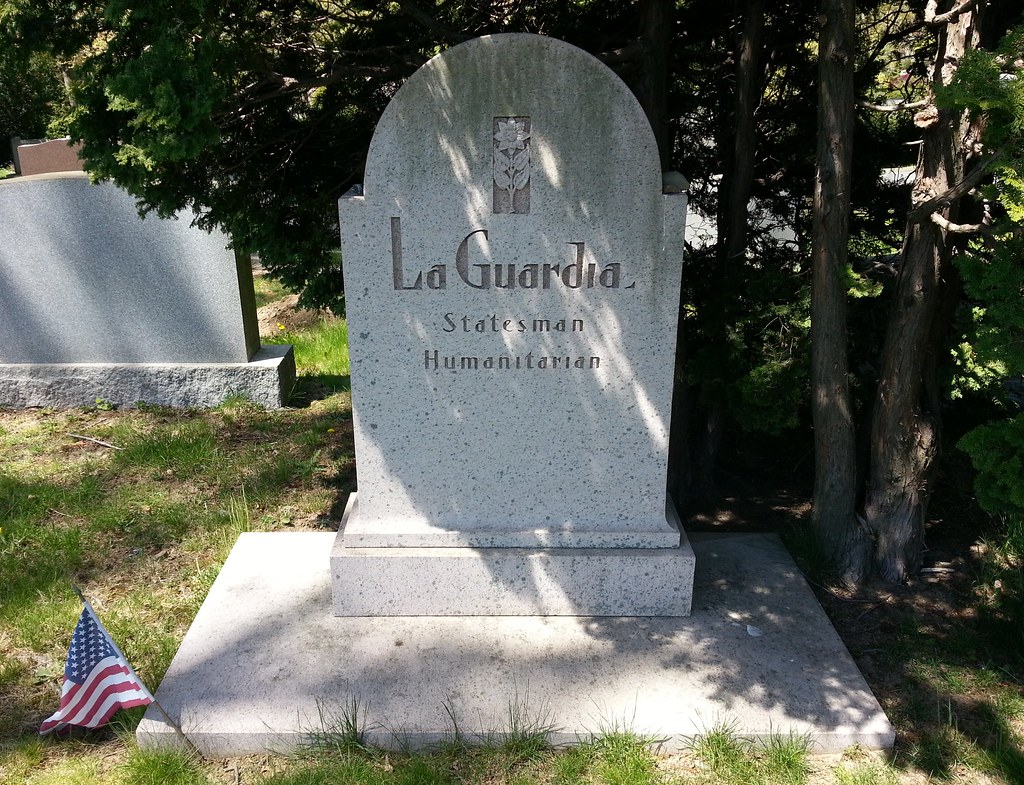
From Mayor La Guardia's 1947 NY Times obituary:
[He] was only about 5 feet 2 inches in height, a rotund little man with a swarthy skin and a belligerent independence that often verged on irascibility. A forelock of black hair invited comparison with Napoleon. His voice was high, and in debate often became a screech. . . .
A crusader all his life in the interests of the underprivileged and the oppressed, the "Little Flower" was a clever showman whose campaigns were always spectacular and whose battles against corruption and special privileges were usually successful. His enemies sometimes called him a demagogue, but to his followers he was a latter-day St. George, bent on slaying the Tammany Tiger rather than the fabled dragon.
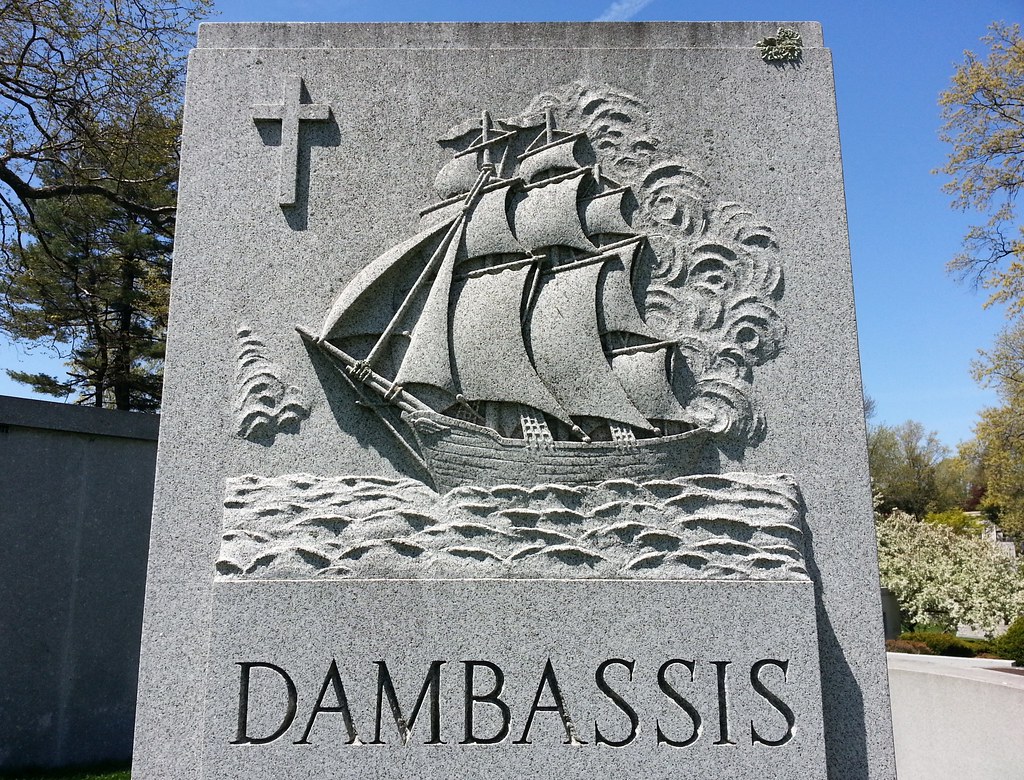
This stone lists the family's patriarch as a "Captain Demosthenes"; perhaps he is the wealthy Greek shipper of the same name mentioned in this 1968 column by Suzy Knickerbocker about that summer's coming-out parties for debutantes in Newport and the Hamptons.

Celia Cruz's mausoleum, which she shares with her late husband, was designed to accommodate her loyal following. There are clear windows on the sides, allowing people to peer in, and "someone comes in on a regular basis, cleans it out and changes the photos so there’s always something for the fans to see."
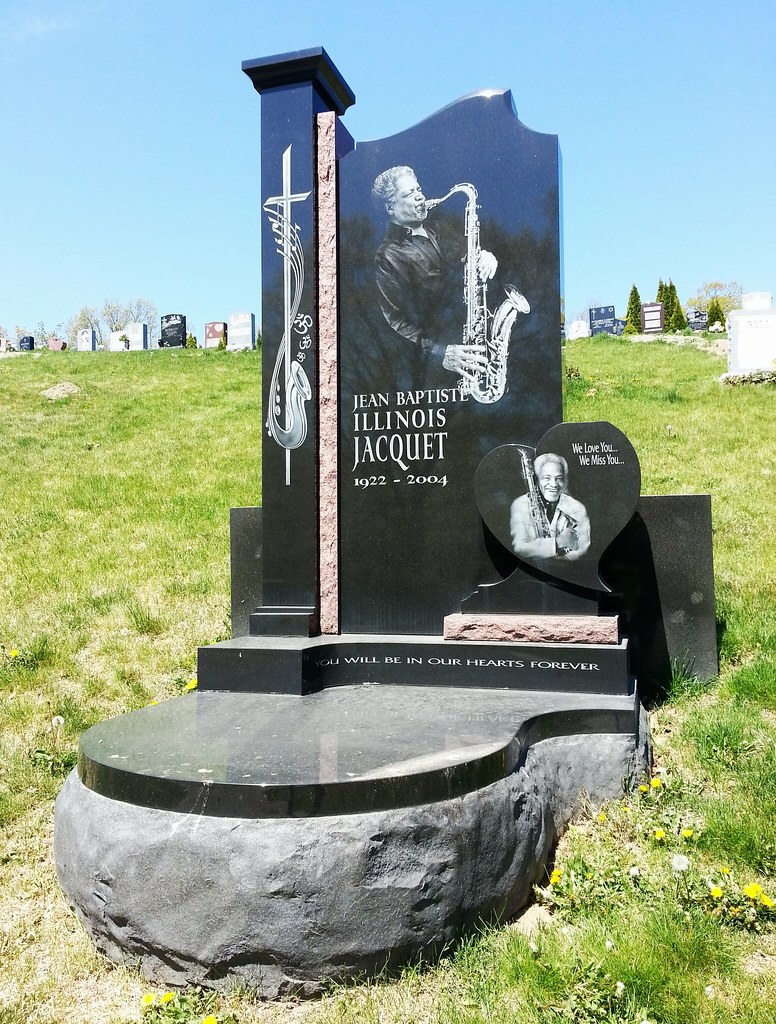
Illinois Jacquet. Also buried here at Woodlawn's "jazz corner" are Lionel Hampton and Max Roach, and the graves of many other jazz greats, such as W.C. Handy and Coleman Hawkins, can be found scattered throughout the cemetery as well. Roach's headstone is inscribed with the last of the 10 free-form haikus that Sonia Sanchez composed for the legendary drummer after his death:
your hands
shimmering on the
legs of rain
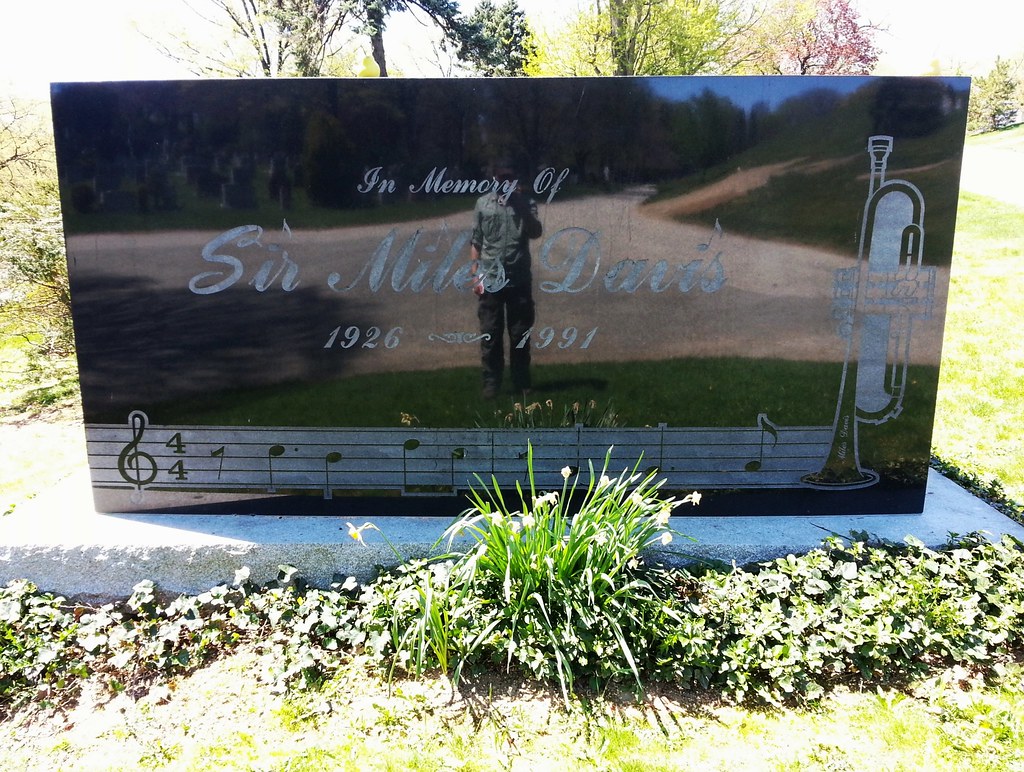
Woodlawn's "jazz corner" (see next post) began to take shape back in 1992, when Miles was laid to rest near the Duke. Here's what the co-author of Davis's autobiography had to say about the two great musicians spending eternity together:
Their spirits are running back and forth . . . They probably got all the worms and everybody doing it. Two people like that together, the energy force of the spirits, the ancestral spirits and their own genius must be too heavy. There must be some heavy stuff.In case you were wondering, and even if you weren't, those are the first two measures of "Solar" engraved on the stone. While searching for a recording of that tune, I found Davis's beautiful rendition of a song that has been a favorite of mine ever since I walked through Wisconsin.
(For the record, this is not the only Miles Davis monument that can be found in the Bronx.)
(Also, for the record, someone had left Miles an offering of two pears on top of his headstone.)
I'm walking every street in New York City.
This is the counterpoint to my walk across the US. Instead of seeing a million places for just a minute each, I'm going to spend a million minutes exploring just one place. By the time I finish walking every block of every street in all five boroughs, I'll have traveled more than 8,000 miles on foot — all within a single city. Details!
Email me at matt@imjustwalkin.com
Subscribe to my email list
Maps: Progress | Photos

~9,954 miles walked
Your donations allow me to keep walking full-time. If you think what I'm doing is valuable and you'd like to offer some support, I would be very grateful. On the other hand, if you think I'm a worthless bum, feel free to email me and tell me to get a job, bozo. Both are excellent options!
