
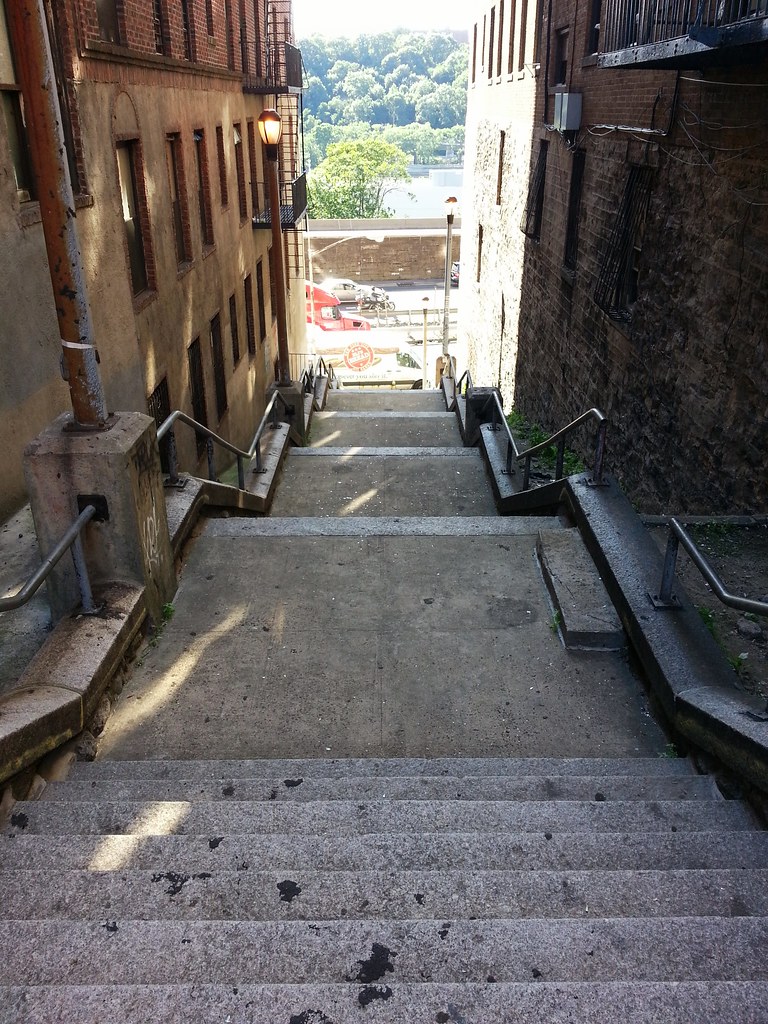
Those are the treed slopes of Manhattan's Highbridge Park across the Harlem River.

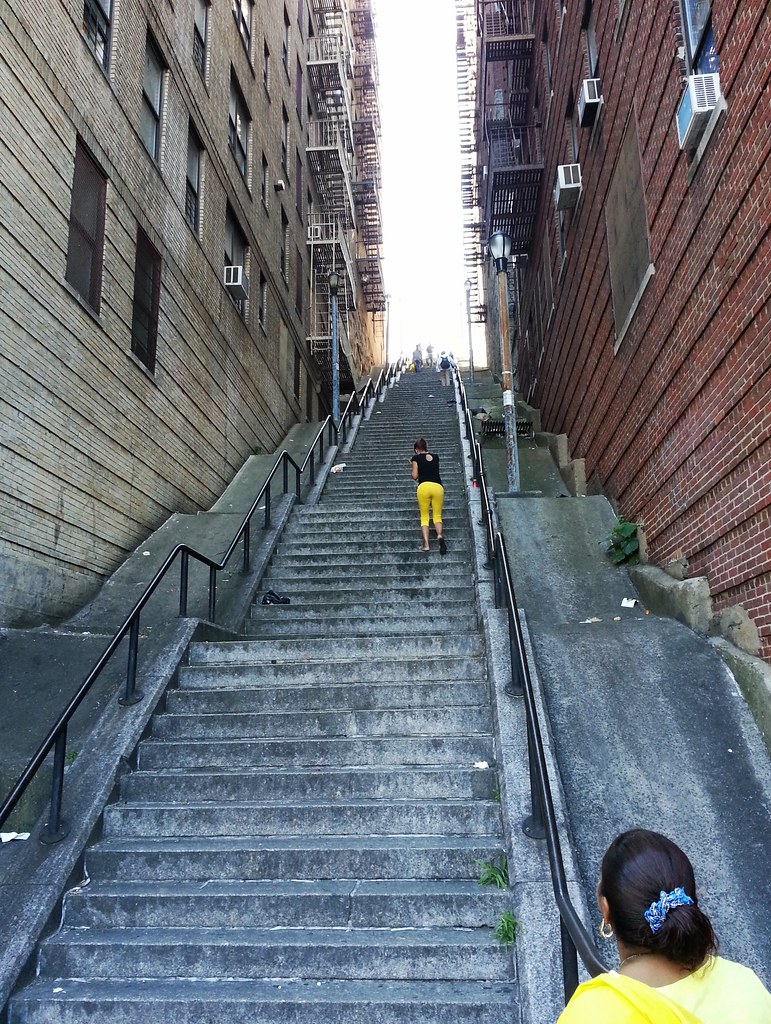

To walk all around the neighborhood of Highbridge is to walk up and down ten million stairs. Ahead: one of many precipitous drops I would encounter on my route today.

On several occasions, I've seen vehicles pull up to open fire hydrants and drive really slowly through the spray. It seems like this would only get about one-third of your car clean-ish (and you can't turn around to wash the other side on these one-way streets), but, hey, who doesn't love free stuff?
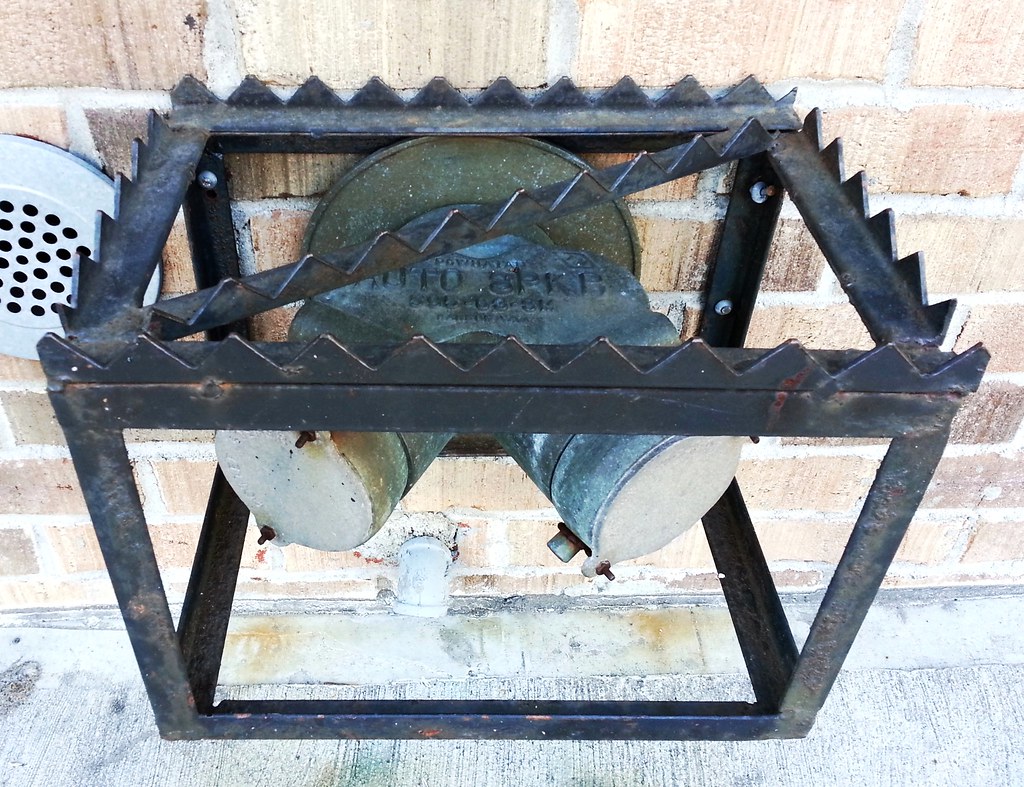
Meanwhile, on the other end of the spectrum...
Or is this the other end of the spectrum? More precise spectrum definition needed!
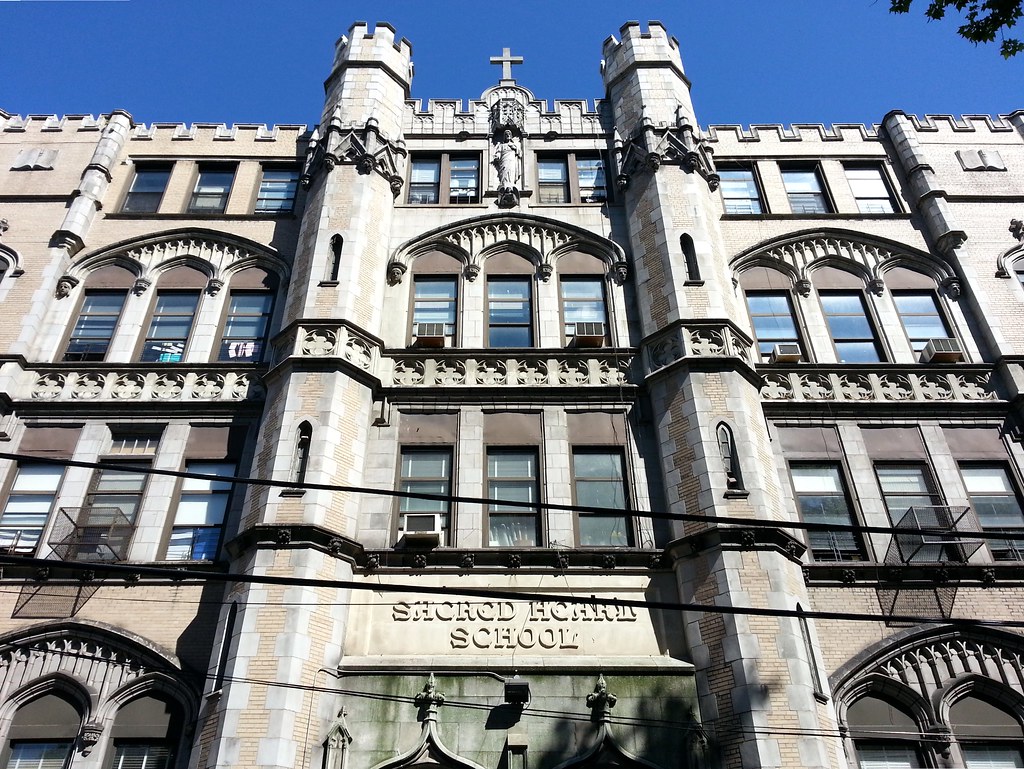

The former Grammar School No. 91, "one of the finest examples of the [Romanesque Revival] style in the Bronx", was built in 1889 "of brick and Harlem River stone". It was designed by George W. Debevoise, the predecessor of Charles B.J. Snyder.
In 1895, when the school was "known for its cleanliness, the entire building being especially inviting", a delegation of visiting school officers was "entertained at assembly by singing from the school, solos from two young lady pupils, and an attractive drill with umbrellas and dumb bells. The visitors expressed their gratification with the discipline of the school and the uniformly neat and refined appearance of the children."
This hillside array of grates, located near the Bronx end of the Concourse Tunnel (which carries the B and D trains beneath the Harlem River), is presumably used for subway ventilation.
The Harlem River lighthouse is now orange! It was repainted by a self-storage firm that has taken over the property since our last visit.
From left to right, starting at the top: Puerto Rico (x5), Dominican Republic, Cuba, Jamaica, Trinidad and Tobago, Mexico, Honduras, the Pan-African flag, Guatemala, Ecuador, and the US
This was merely an exhaust stack for the old Yankee Stadium until Joe Garagiola Jr. reportedly had the idea to ask Hillerich & Bradsby, the company that makes Louisville Sluggers, to stick a knob-like protrusion on the top and turn it into a gigantic Babe Ruth-model bat. Predating the peeling tape on the handle, supersized versions of the batmaker's logo and the Babe's signature once adorned the shaft, but seem to have been lost to subsequent paint jobs. The Bat became a popular meeting place for fans outside the old stadium, and, while the stadium has since been torn down, The Bat remains, now towering above Heritage Field and the passageway to the new Metro-North station.
"I thought it would be nice to take the stars and de-brand them in a way."
This piece by Ellen Harvey (more photos and info here) lines a passageway at the Yankee Stadium Metro-North station. According to the artist:
The mosaic consists of eleven 18 ft. by 6.75 ft. panels. The panels show a sunset and moon and star rise in 15 minute increments, starting at 6.30pm (the time most Yankee fans would be arriving at the train station for an evening game) and ending at 9 pm. The sky depicted is based on watercolors based on photographs of a typically spectacular Bronx sunset and the location of the sun, moon and stars are those that viewers would experience gazing in the direction of the walkway wall in April of 2009 (the completion date of the new Yankee Stadium). Of course, given the light pollution of the city, the stars in the final panels of the mosaic would never actually be visible to the naked eye.
Initially, I thought these might be seats salvaged from the old Yankee Stadium bleachers, the former home of the Bleacher Creatures, but, after poking around on the web for a bit, I can see that they're not. My search wasn't entirely in vain, however, as it led me to this 1956 poem by a young John Updike:

Tao in the Yankee Stadium Bleachers
Distance brings proportion. From here
the populated tiers
as much as players seem part of the show:
a constructed stage beast, three folds of Dante’s rose,
or a Chinese military hat
cunningly chased with bodies.
“Falling from his chariot, a drunk man is unhurt
because his soul is intact. Not knowing his fall,
he is unastonished, he is invulnerable.”
So, too, the “pure man”—“pure”
in the sense of undisturbed water.
“It is not necessary to seek out
a wasteland, swamp, or thicket.”
The opposing pitcher’s pertinent hesitations,
the sky, this meadow, Mantle’s thick baked neck,
the old men who in the changing rosters see
a personal mutability,
green slats, wet stone are all to me
as when an emperor commands
a performance with a gesture of his eyes.
“No king on his throne has the joy of the dead,”
the skull told Chuang-tzu.
The thought of death is peppermint to you
when games begin with patriotic song
and a democratic sun beats broadly down.
The Inner Journey seems unjudgeably long
when small boys purchase cups of ice
and, distant as a paradise,
experts, passionate and deft,
hold motionless while Berra flies to left.
I'm walking every street in New York City.
This is the counterpoint to my walk across the US. Instead of seeing a million places for just a minute each, I'm going to spend a million minutes exploring just one place. By the time I finish walking every block of every street in all five boroughs, I'll have traveled more than 8,000 miles on foot — all within a single city. Details!
Email me at matt@imjustwalkin.com
Subscribe to my email list
Maps: Progress | Photos

~9,954 miles walked
Your donations allow me to keep walking full-time. If you think what I'm doing is valuable and you'd like to offer some support, I would be very grateful. On the other hand, if you think I'm a worthless bum, feel free to email me and tell me to get a job, bozo. Both are excellent options!
