
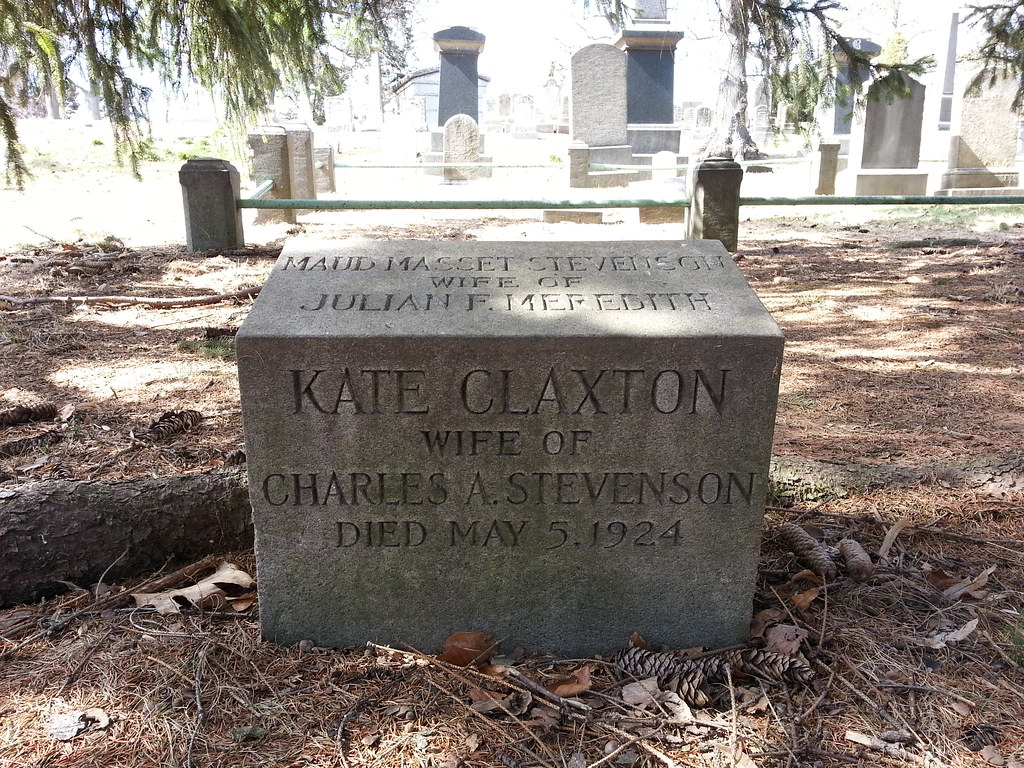
A popular actress, Ms. Claxton was on stage during the 1876 Brooklyn Theatre fire that killed at least 278 people (a disaster that has its own memorial here at Green-Wood). After a deadly fire broke out in a St. Louis hotel where she was staying a few months later, the press started suggesting it was bad luck to have her in a building, with some publications even printing jokes and making up phony stories about her. This treatment of Ms. Claxton was sufficiently widespread that Thomas Nast was inspired to draw a cartoon in Harper's Weekly mocking the dishonorable journalists who had been writing such things.

From the NY Times, August 27, 1988:
In a city that exalts successful artists in the fashion of rock stars, Jean Michel Basquiat seemed blessed. When he burst onto the art scene in 1981, his paintings of anguished figures were hailed by some critics as works of genius. Admirers besieged him at Manhattan's hottest night clubs. Sales of his art grossed millions of dollars.(His next-door neighbor had some family visiting today.)
Mr. Basquiat was 27 years old when he was found dead in his apartment in the East Village on Aug. 12 from what friends say was an overdose of heroin.
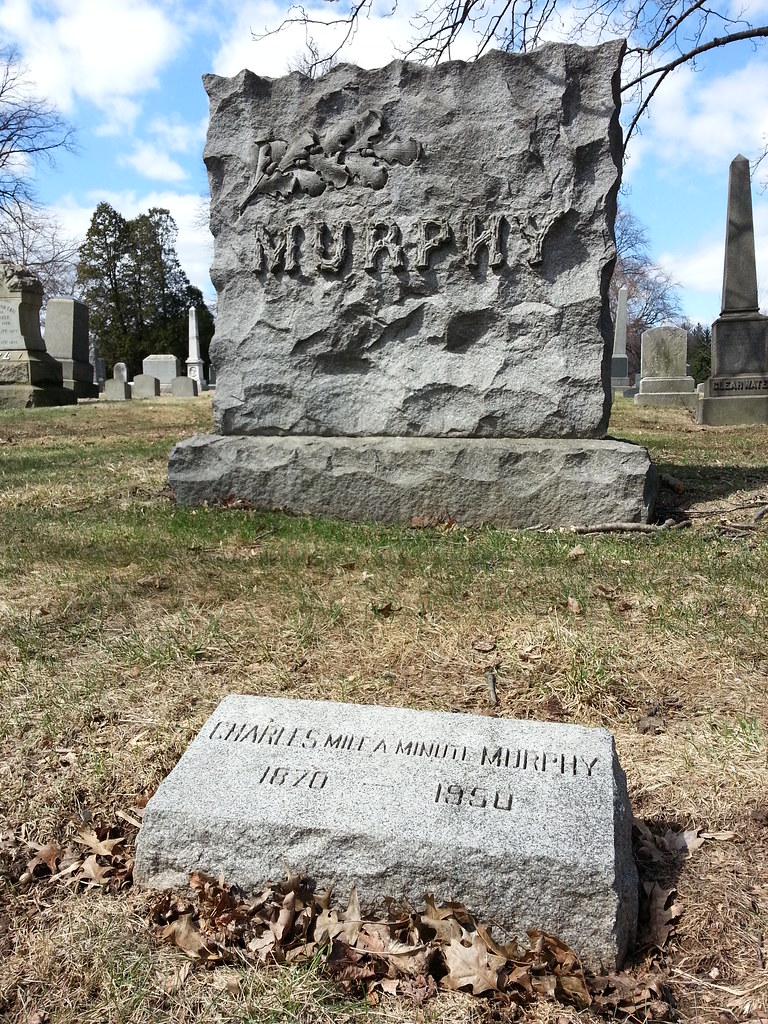
Charles Minthorn Murphy was the first man to ride a mile on a bicycle in less than a minute. He did it in 1899 by furiously pedaling in the slipstream behind a speeding Long Island Rail Road train (photo) on a section of track where boards had been overlaid on the ties to create a smooth riding surface.
Some excerpts from Murphy's own account of the event:
Within five seconds the rate of speed was terrific; I was riding in a maelstrom of swirling dust, hot cinders, paper and other particles of matter. The whipsaw feeling through a veritable storm of fire became harder every second . . .Read the rest here.
I could feel myself getting weaker every second.
I was closely following into the maelstrom of dust, which whirled, eddied and rushed in a shrieking, roaring turmoil and pandemonium about me. The suspense became maddening. All kinds of unpleasant things passed through my mind. I saw ridicule, contempt, disgrace and a lifetime dream gone up in smoke.
As I looked up I saw the agonized faces, yelling, holding out stretched hands as if they would like to get hold of or assist me somehow.
They sent the thrill of determination through me. . . .
Then I pedalled through the fire of hot cinders and rubber, but with each sting it made me more determined. . . .
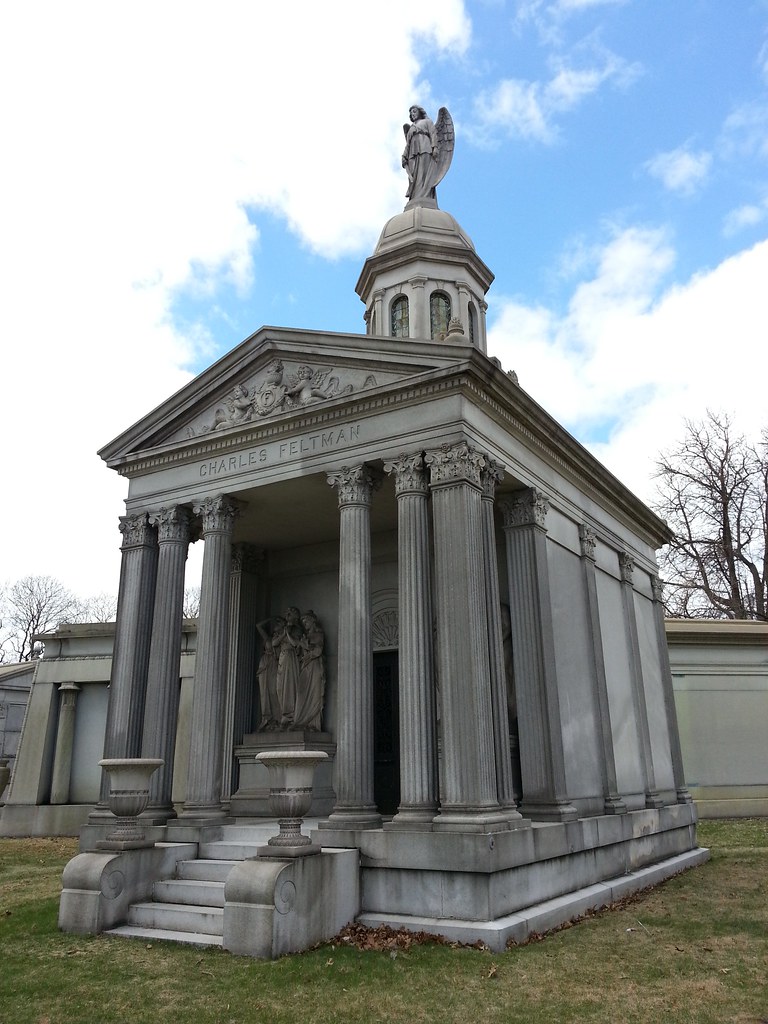
It's a matter of some dispute, but Charles Feltman is often credited with inventing the hot dog. Whether or not the German immigrant was the first person to put a sausage in a bun, he began selling the creations to Coney Island beachgoers sometime around 1870. Finding success as a wiener slinger, he expanded his operations into what eventually became a massive 8,000-seat restaurant complex that was known for its seafood but, of course, still served plenty of hot dogs as well. (The last remaining building from the complex, a kitchen, was torn down a few years ago. Officials from the Coney Island History Project staged a hoax, reported as fact by CNN, in which they "found" a 140-year-old frankfurter preserved in ice beneath the leveled building. They had actually prepared the ice-encased dog elsewhere and snuck it into the demolition site.)
Feltman died in 1910, but his restaurant stayed in business, and it was a few years later that a young Polish immigrant named Nathan Handwerker found work there slicing rolls. Supposedly with some encouragement and borrowed money from his then-unknown co-workers Eddie Cantor and Jimmy Durante, Nathan opened his own hot dog joint in 1916 at the corner of Surf and Stillwell Avenues, where he and his wife served up frankfurters for just a nickel apiece, half the price his former employer charged.
According to legend (and Nathan's grandson), with some variations from one telling to another, people were initially skeptical about the quality and contents of a wiener that could be sold for a mere five cents. To alleviate these concerns, Nathan hired people to dress as doctors and eat hot dogs in front of his stand, giving the impression that medical professionals considered his food perfectly healthy. Before long, with the arrival of the subway in Coney Island (and with the terminal station located right across the street), the dogs started selling like crazy, and now, almost a century later, Nathan's Famous remains a household name.
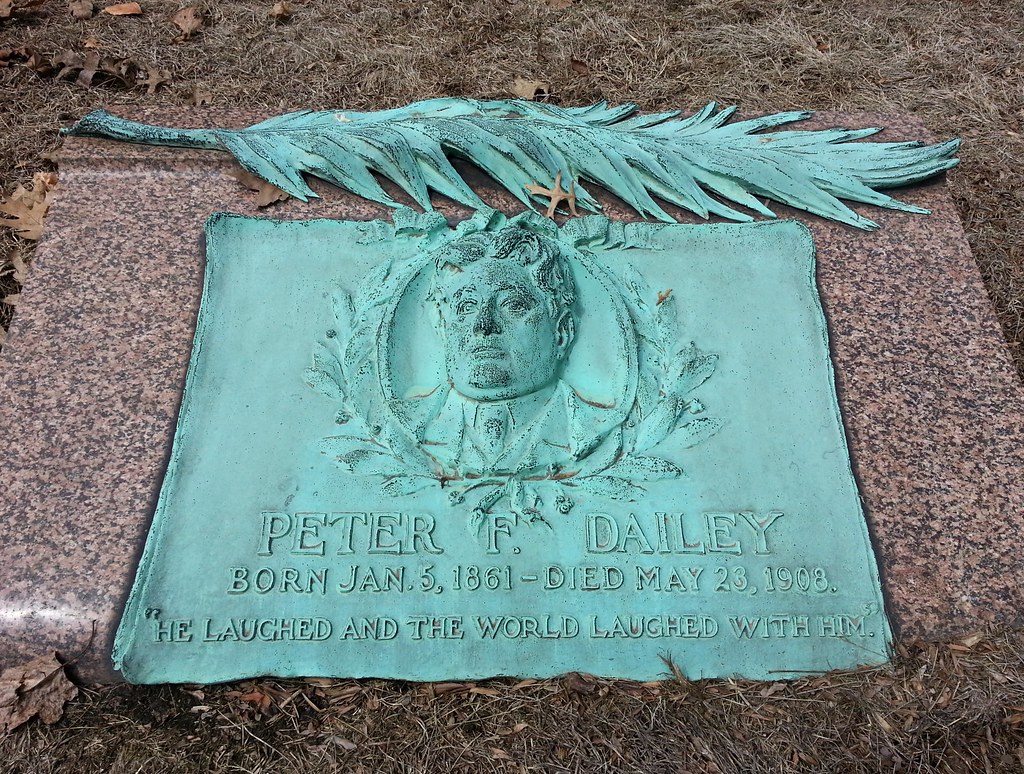
From a 1900 book entitled Famous Stars of Light Opera:
Peter F. Dailey is a great actor in the extremely popular character of Peter F. Dailey, a part that he has played successfully, under various guises and amid diverse environments, for many seasons. It is not a highly complex role at that; it does not sink very deep into the bed-rock of human nature: it would be ridiculous in the extreme to think of it as even pricking the emotions or stirring ever so remotely the sentiments; its appeal to the intelligence, moreover, is entirely superficial, for the reason that its humour is both colloquial and conventional. Yet it is an immensely entertaining personation, for its spontaneity is perfect, its freshness, ease, and good-fellowship most satisfying, and its humanity, in its limited field of up-to-date Broadway, realistic and suggestively true to life. . . .Dailey died in 1908 after contracting pneumonia while starring as the preposterously named Caramel de Jollidog, a "journeyman lover", in a burlesque of The Merry Widow. He is buried in the same family plot as the minstrel Billy West; the two were brothers-in-law, having married a pair of sisters.
Dailey was born with the jester's temperament. Probably his stock of original humour is small, for his wit seems to be imitative rather than creative, and is chiefly remarkable for its nimbleness, timeliness, and adaptability. . . . Dailey's wit has no permanency, and it is often nonsensical and meaningless examined critically and apart from the conditions that gave it birth. It is literally a flash in the pan that catches one unawares, forcing laughter without thought and leaving one as suddenly, in a condition of mental bewilderment as regards the exact cause for the disturbance.
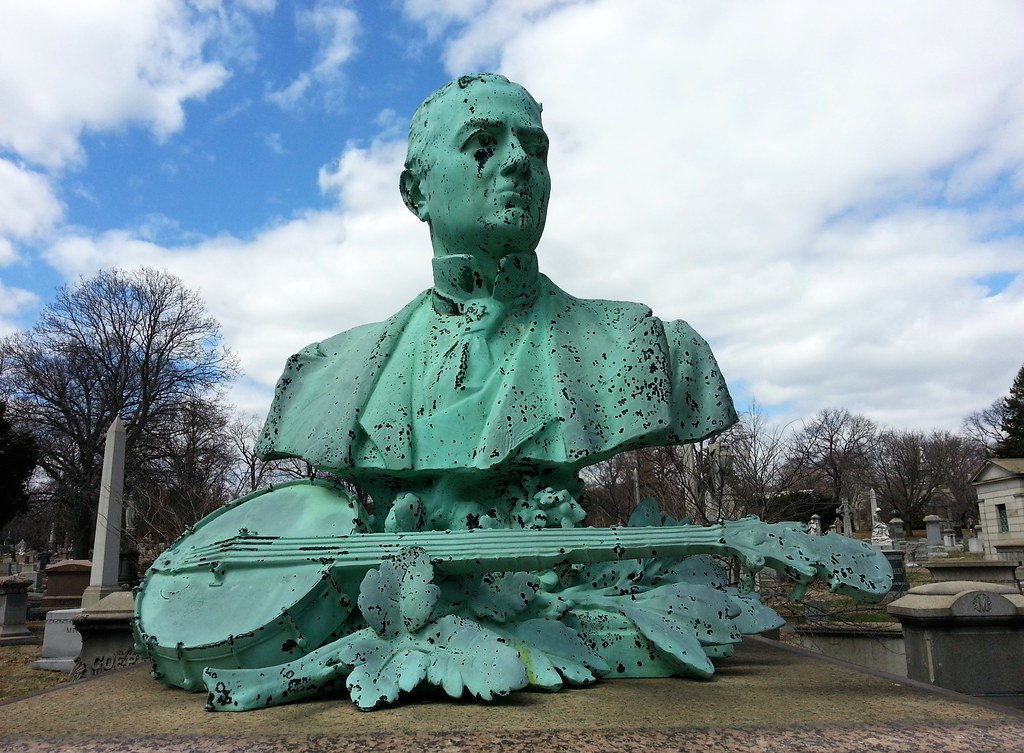
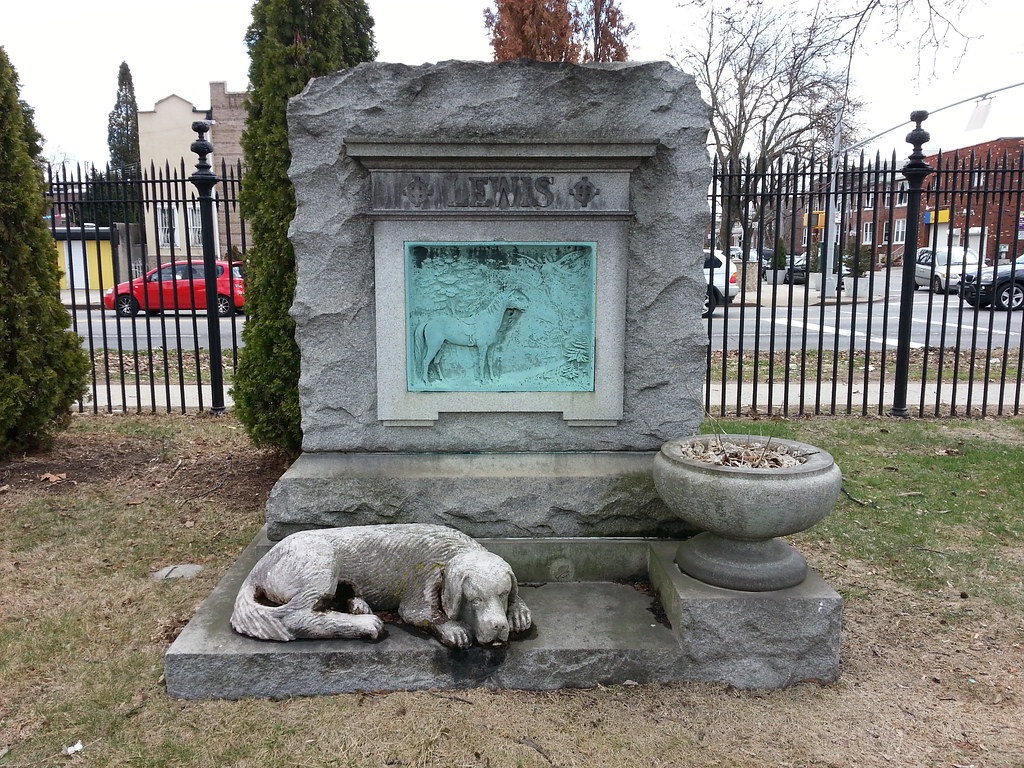

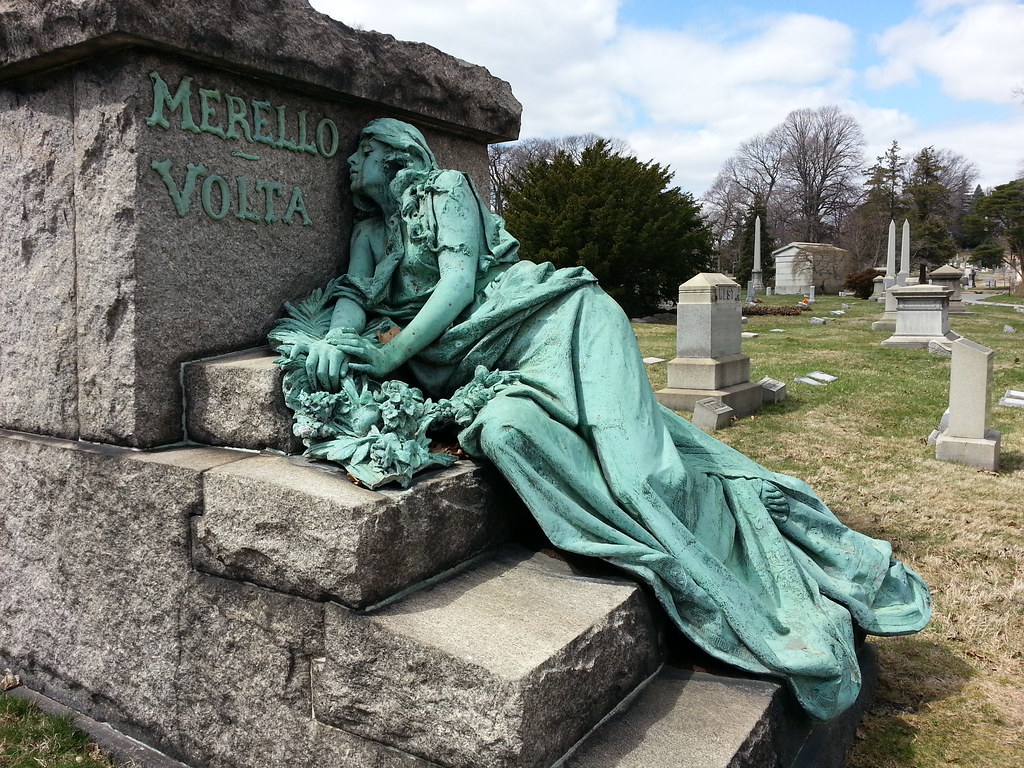
This sculpture commemorates Rose Guarino, who was shot to death in 1909 by a disgruntled family servant upset over his treatment by a fellow servant. He shot the other servant twice with a revolver; when Mrs. Guarino tried to intervene, he blasted her with a shotgun.
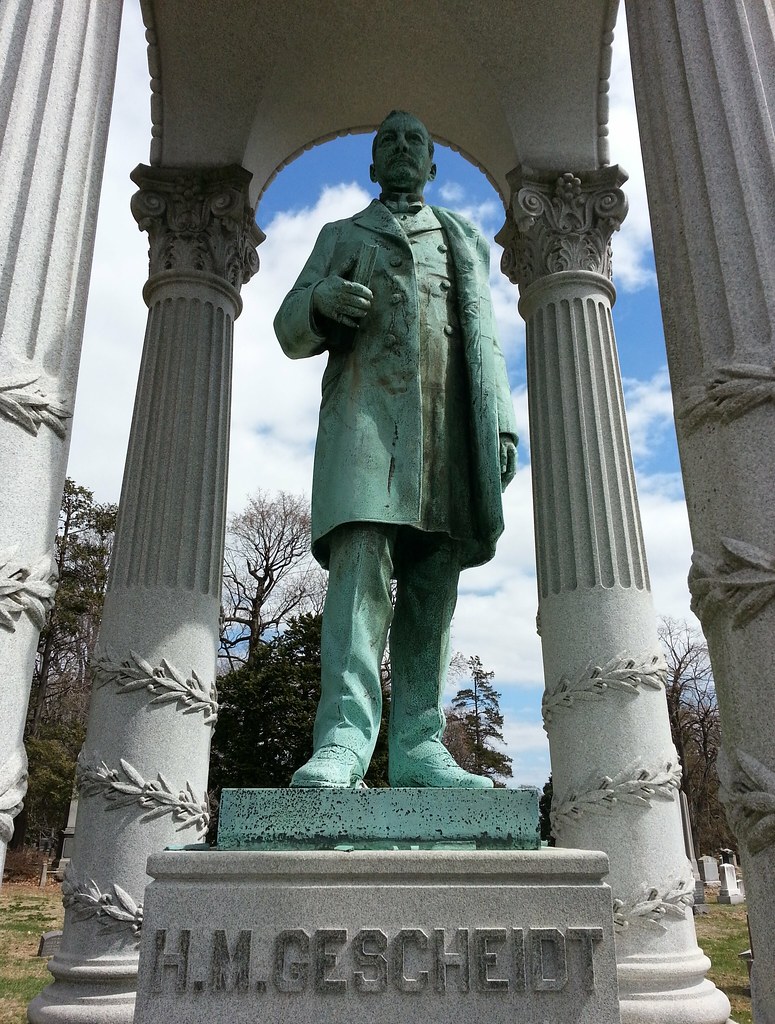
From an NY Times article published shortly after his death in 1914:
Mr. Gescheidt, who recently had a large law practice and an office at 309 Broadway, has for the last twenty years been making elaborate preparations for his death. To his intimates he has frequently confided his desire to be remembered for centuries. With this purpose in view Mr. Gescheidt has in his will provided for the establishment of a bread line, which shall not only be known as the "Gescheidt Bread Line," but he also requires that his name in raised letters be on each and every loaf of bread distributed to the needy who apply for aid.He bequeathed $150,000 to Trinity Church to establish this bread line, but the church turned down the gift "in accord with scientific philanthropic ideas of today", according to another article published a few months later:
Trinity has been saddled for more than a century with one such charity, known as "The Leake Dole." Through its provisions loaves of bread are distributed every Saturday morning to the poor of one of the lower West Side Trinity parishes. The Leake Dole does not fill a want of any marked character, but it must be maintained. It has been the experience of charity workers in Great Britain, where the dole flourishes for making curious gifts to the poor, that the establishment of such philanthropy in a parish often spells decadence and ruin for the parish. This is due to the fact that a worthless class of persons invade such parishes to take advantage of the dole, being content to exist on that. The scheme worked out by Gescheidt for the establishment of a bread line and for the stamping of his name on each loaf belongs to the order of bequest made many years ago in England for a dole of a bottle of port wine and a leg of veal to be given to every convalescent discharged from the hospital in a certain parish. When that dole was made port wine and veal were looked upon as luxuries, and the donor of the dole never considered what effect such heavy meat and drink would have on the poor recipient. He had a warm heart, as Mr. Gescheidt had, but neither of these charitably-minded men viewed his gift in its future economic aspect.




As pants the hart for cooling streams...
(Inside the Goodnough mausoleum.)
I'm walking every street in New York City.
This is the counterpoint to my walk across the US. Instead of seeing a million places for just a minute each, I'm going to spend a million minutes exploring just one place. By the time I finish walking every block of every street in all five boroughs, I'll have traveled more than 8,000 miles on foot — all within a single city. Details!
Email me at matt@imjustwalkin.com
Subscribe to my email list
Maps: Progress | Photos

~9,954 miles walked
Your donations allow me to keep walking full-time. If you think what I'm doing is valuable and you'd like to offer some support, I would be very grateful. On the other hand, if you think I'm a worthless bum, feel free to email me and tell me to get a job, bozo. Both are excellent options!
