
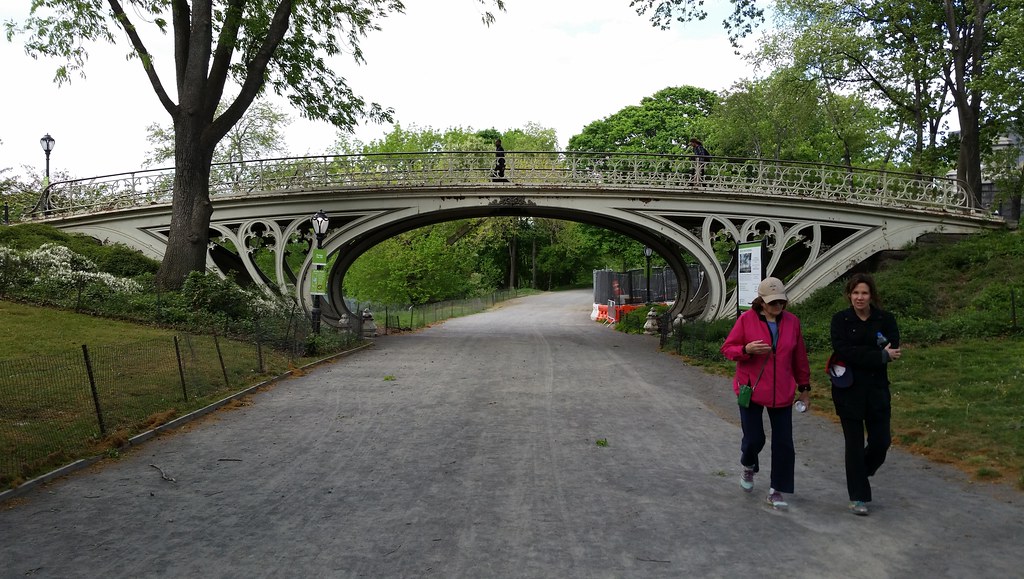
a.k.a. Gothic Bridge

across the Central Park Reservoir toward the twin towers of the Eldorado
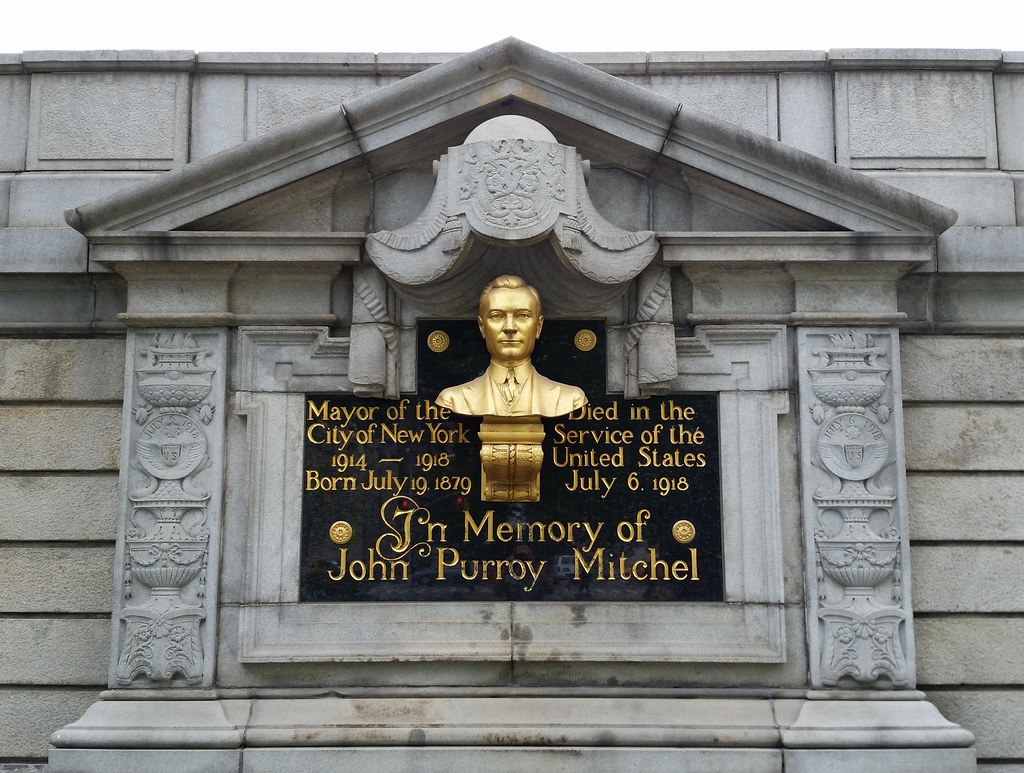
This memorial is located on the eastern embankment of the Central Park Reservoir. The bust was sculpted by Adolph Weinman, and the granite stele was designed by Thomas Hastings and Donn Barber.
From a previous post about Mayor Mitchel:
Known as the "boy mayor", he was sworn in at the tender age of 34, making him the second-youngest mayor in the city's history, and the youngest to preside over the modern five-borough city.UPDATE: Mitchel is prominently featured in a song released by Joanna Newsom in August 2015, a meticulously crafted and densely allusive track called Sapokanikan. The first lines specifically pertaining to the boy mayor start at 2:53. If you read the NY Times's account of his death — specifically, the two paragraphs before and the four after the "Joked About City Politics" section heading — you'll find a number of phrases that have made their way into the song's lyrics.
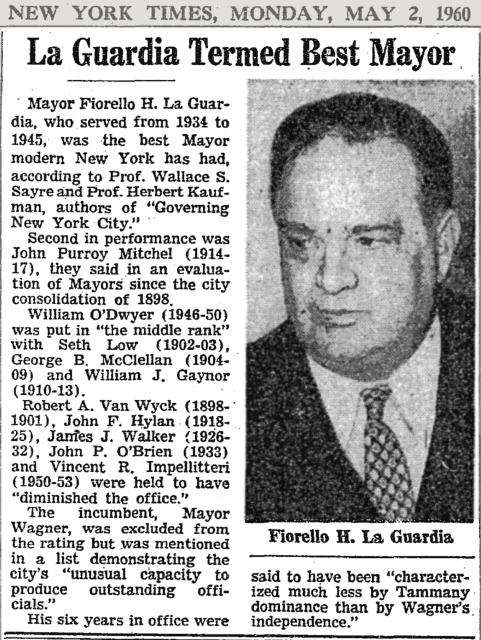
An anti-Tammany reformer, Mitchel is widely considered to have been an effective and honest mayor. He was greatly admired by Fiorello La Guardia (the only NYC mayor to rank ahead of him in a "classic" 1960 study), whose mayoral speeches "rang with Mitchel's name". Teddy Roosevelt was also a big fan. Endorsing Mitchel's bid for re-election in 1917, Roosevelt wrote that Mitchel had "given us as nearly an ideal administration of the New York City government as I have seen in my lifetime, or as I have heard of since New York became a big city."
But despite his popularity among reform-minded, good-government types, Mitchel lost the 1917 race in a historic landslide. He may have been a good mayor, but he was a crummy politician — and he knew it. In fact, he had to be talked into running for a second term, as he believed, correctly as it turned out, that he would be unable to win. According to his secretary:He knew just enough about politics to know that, unless an officeholder strives to please groups and factions to the sacrifice of real efficiency, re-election is impossible. Many times, in going over stacks of invitations, which came to him daily, I would urge him to go to this or that function, which was uninteresting and dull, but at which his attendance would please some group or section of the city. . . . He would absolutely refuse to attend these affairs, and when I would insist out of consideration for the fact that he was making political friends, he invariably replied that he had no desire to gain ground politically, that he was through with political life after this term, and that he merely wished to do the immediate job that lay before him the best he could.Shortly after leaving office, at the age of 38 and with World War I raging, Mitchel joined the Army's aviation service. The former boy mayor thus became "America's oldest flying cadet". But just a few months later, during a training exercise in Louisiana in 1918, he fell out of his plane and plummeted 500 feet to the ground, dying on impact. He had not been wearing his safety belt.
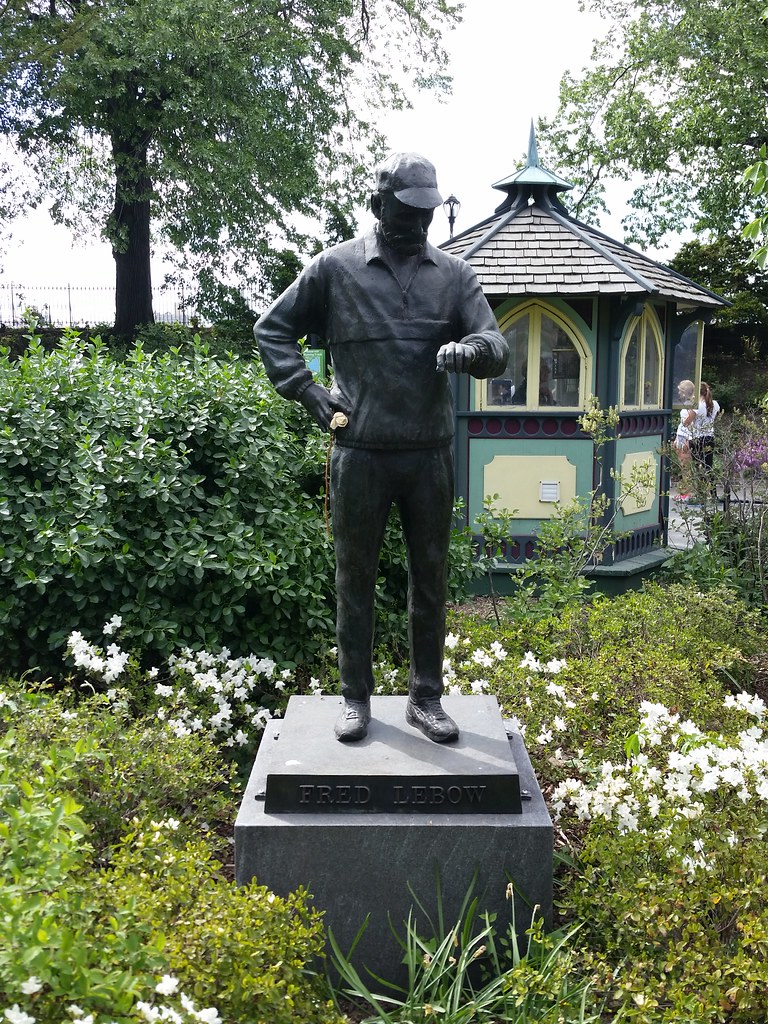
Central Park, which hosted the first few New York City Marathons in the 1970s and is still home to the final stretch of the race, is a fitting place for a memorial to Fred Lebow, the marathon's founder. But when Mr. Lebow died in 1994, a moratorium on new monuments in the park prevented a permanent memorial from being erected. So a sneaky solution was worked out: his statue is allowed to stand here as a temporary installation — and what makes it technically temporary is that it's moved from its perch once per year, when it's set up to greet runners at the marathon's finish line.
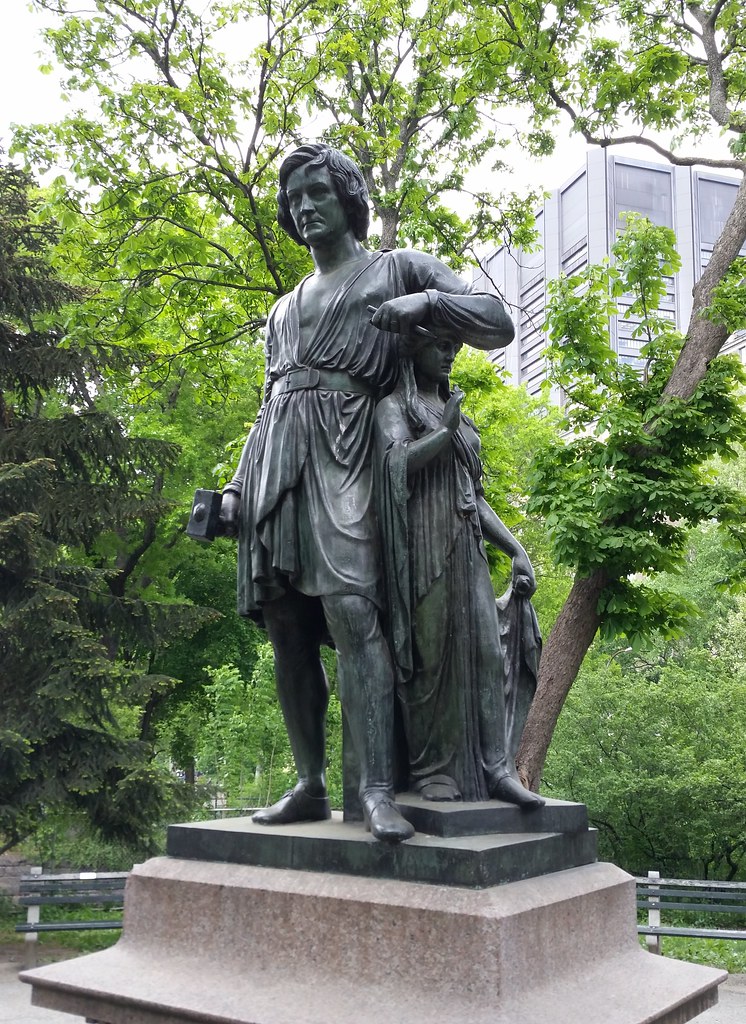
According to the Parks Department:
This bronze, life-sized sculpture is a self-portrait of the esteemed Danish sculptor [Bertel] Thorvaldsen (1770–1844), and was dedicated in Central Park in 1894. It is the only statue of an artist displayed in the parks of New York City*, and honors a titan in his field who had broad influence in sustaining the classical tradition in art. . . .* The only statue of an artist in an NYC park? Not even close. It may be the only statue of a visual fine artist, but there are plenty of statues of other types of artists (musicians, writers, an architect) located in city parks. Here in Central Park alone, we have Duke Ellington, Ludwig van Beethoven, Victor Herbert, William Shakespeare, Hans Christian Andersen, Robert Burns, Sir Walter Scott, Fitz-Greene Halleck, Friedrich Schiller, and Richard Morris Hunt. At the Concert Grove in Prospect Park, you can find busts of Beethoven, Wolfgang Amadeus Mozart, Carl Maria von Weber, Edvard Grieg, Washington Irving, and Thomas Moore. There's a statue of William Cullen Bryant in Bryant Park and one of Antonin Dvorak in Stuyvesant Square. And there are probably others I've neglected to mention as well.
The original marble self-portrait, on which this posthumous bronze replica is based, was carved in 1839. . . . Though in his seventh decade of life when he created this work, Thorvaldsen represented himself as a younger, idealized man draped in a workman’s robe, with his hands holding the tools of his trade: mallet and chisel. His left arm rests on a small female figure, a copy of his figure of Hope, modeled in 1817.
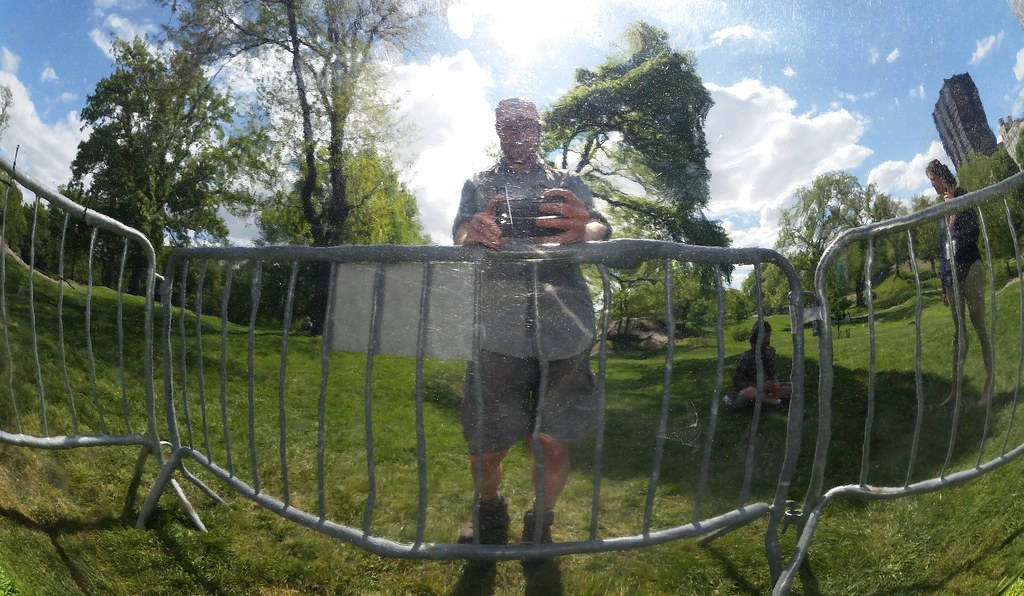
This "poetic postbox" (there's a mail slot in it) in Central Park "invites passersby to send missives to those with no earthly address via a sculptural globe that reflects the earth and sky. Postcards provided."
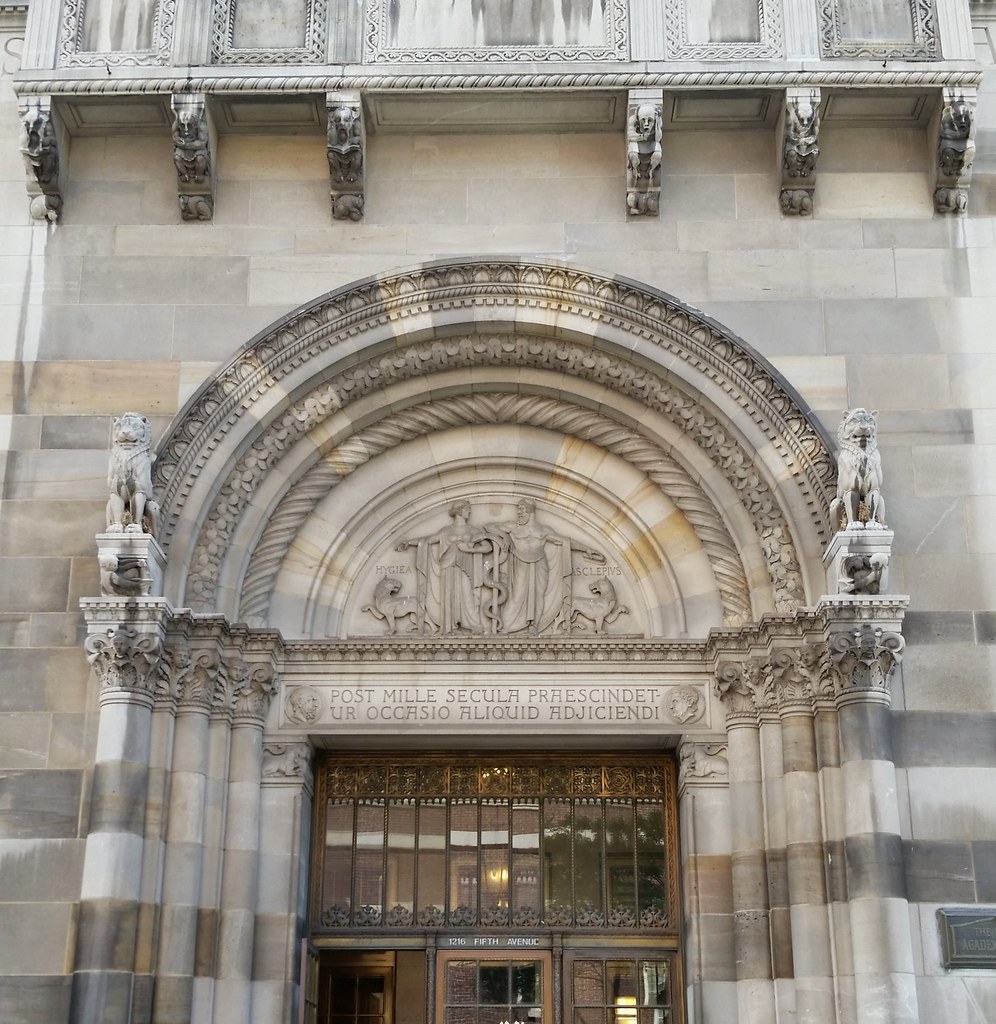
Completed in 1927, the academy's building is home to, among other things, "one of the most significant historical libraries in medicine and public health in the world". The library, which was started back in 1847, now holds more than 550,000 volumes, including an extensive rare book collection that "contains 85 to 90 percent of the medical books printed in what is now the United States between the late 17th and early 19th centuries".
There are also many historical artifacts in the library's possession, such as the lower half of a set of George Washington's dentures, made from human teeth set in hippopotamus ivory and designed to fit around the president's last remaining tooth — which, by the way, the academy also owns!
You can view some samples of the library's holdings here (relatively tame) and here (relatively gruesome), and you can see a 360-degree panorama of the beautiful rare book reading room here. You can also go visit the library in person; it's been open to the public since 1878. Just make an appointment or show up for one of the monthly tours.
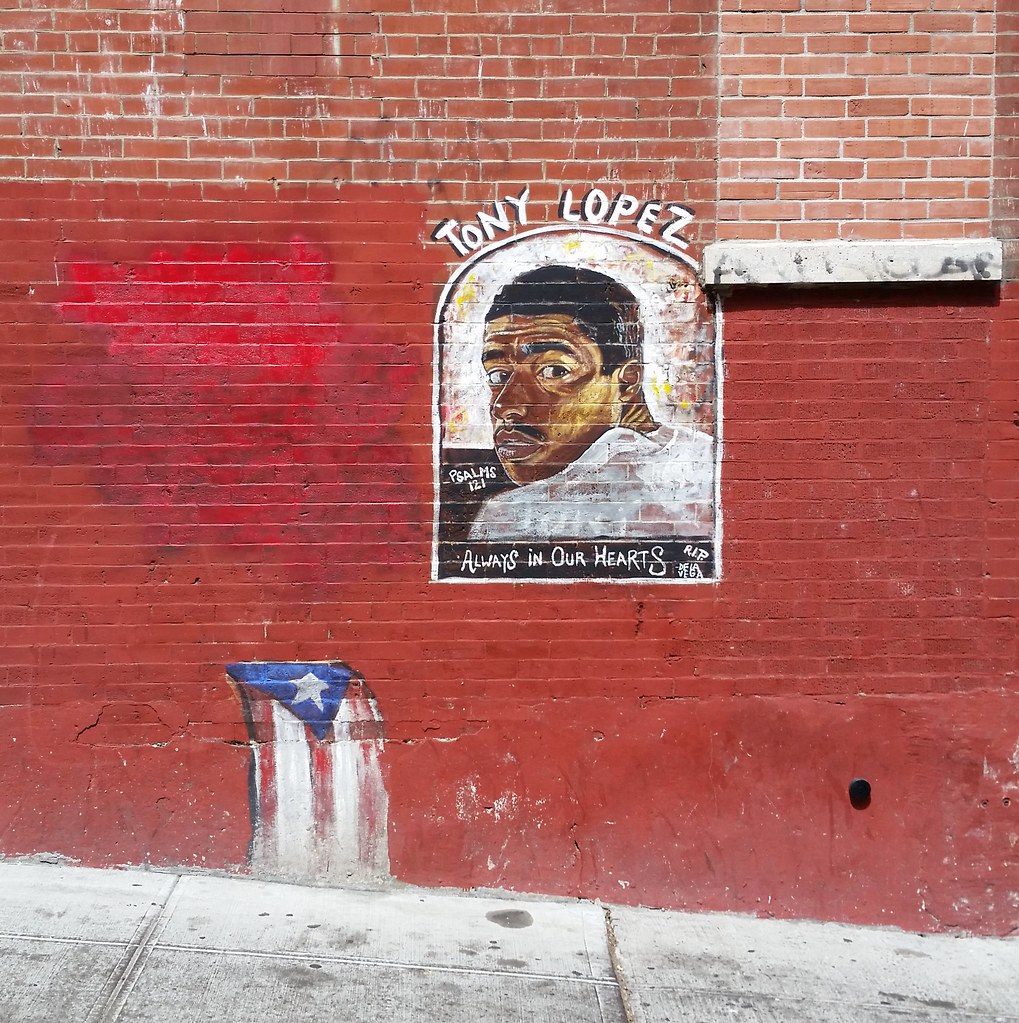
by James De La Vega
This memorial is located on East 100th Street. I wonder if this Tony Lopez is the same one mentioned in this article as being the superintendent of nine buildings on East 100th Street.

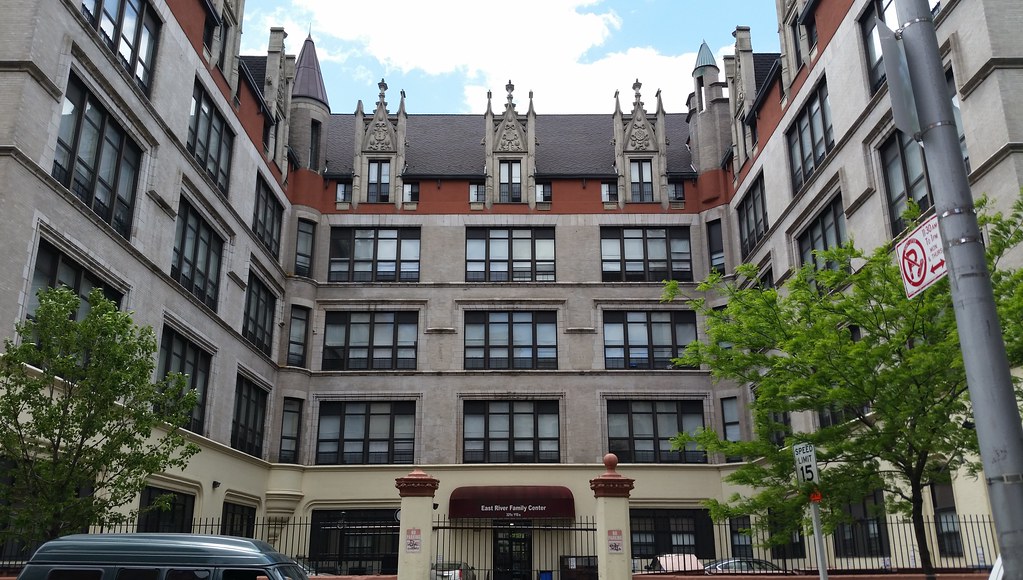
The East River Family Center, a homeless shelter, now occupies this old public school. In 1976, a teenager named Randall Dana removed some gargoyles from the dormer windows of the then-abandoned building, adding them to what was becoming a massive collection of salvaged architectural ornaments from around the city. He later sculpted his own versions of the original gargoyles (1, 2, 3, 4) and now offers them for sale along with other similar works.


I'm walking every street in New York City.
This is the counterpoint to my walk across the US. Instead of seeing a million places for just a minute each, I'm going to spend a million minutes exploring just one place. By the time I finish walking every block of every street in all five boroughs, I'll have traveled more than 8,000 miles on foot — all within a single city. Details!
Email me at matt@imjustwalkin.com
Subscribe to my email list
Maps: Progress | Photos

~9,954 miles walked
Your donations allow me to keep walking full-time. If you think what I'm doing is valuable and you'd like to offer some support, I would be very grateful. On the other hand, if you think I'm a worthless bum, feel free to email me and tell me to get a job, bozo. Both are excellent options!
