
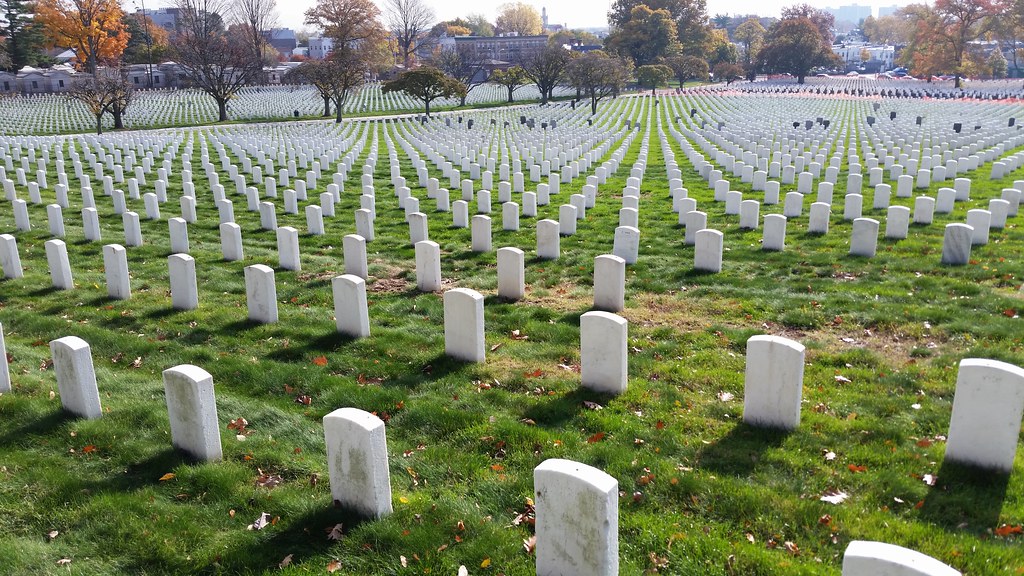
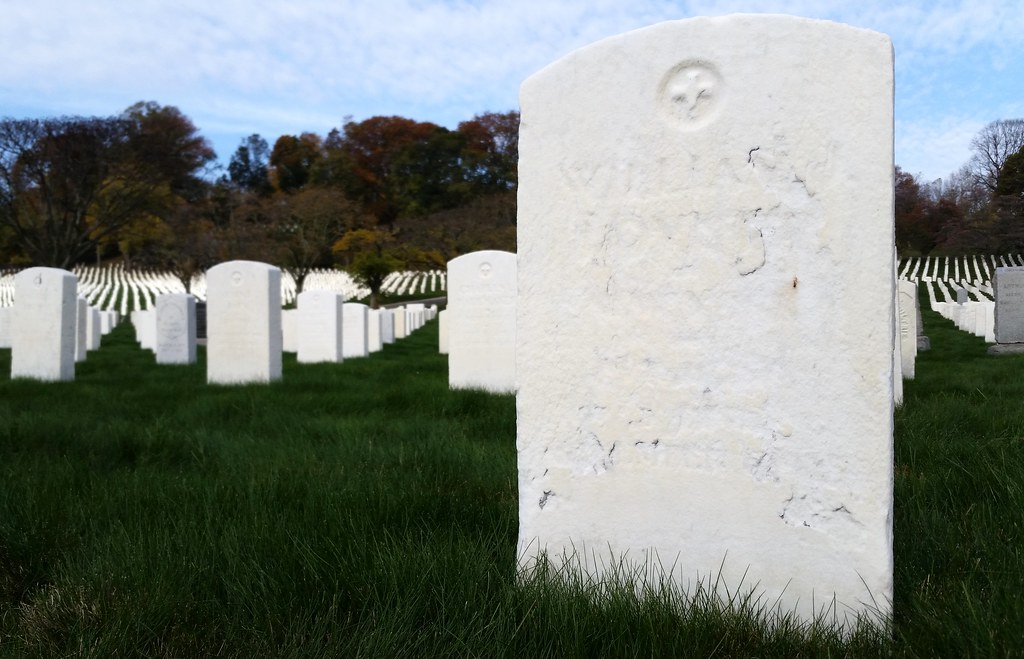
Notorious gangster/war hero.
Here's a colorful story about Lovett's wife Anna and the men in her life. Long story short: her mom shot and killed her dad, Wild Bill was murdered a few months after they wed, her one-legged gangster brother was killed a couple of years later, and then she married another gangster who was shot to death a few years after that. The deaths of her husband, brother, and husband represented the downfall and final collapse of the White Hand gang, the last Irish-American street gang to control the northern Brooklyn waterfront.
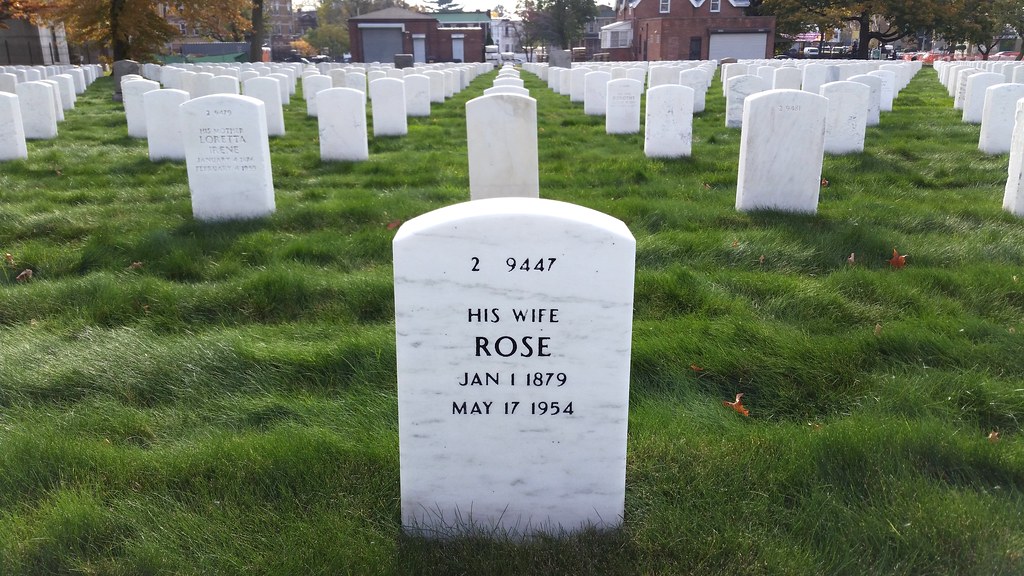
Here at Cypress Hills National Cemetery, you can occasionally spot the name of a military wife/mother on the back of the gravestone of her husband/son. I wasn't paying particularly close attention to such things, but I also noticed, in the officers' sections, several instances of a wife getting her own stone.

The muffled drum's sad roll has beat
The soldier's last tattoo;
No more on life's parade shall meet
That brave and fallen few.
On Fame's eternal camping-ground
Their silent tents are spread,
And Glory guards, with solemn round,
The bivouac of the dead.
That's the first stanza of Bivouac of the Dead (full text), an elegy written by Theodore O'Hara in remembrance of his fellow Kentuckians who died at the Battle of Buena Vista in the Mexican-American War. O'Hara later served as a Confederate colonel in the Civil War, but his poem resonated with veterans from both sides of the conflict and became a popular expression of loss in both the North and the South. Today, its verses can be found in national cemeteries all over the country, including here at Cypress Hills National Cemetery. (Another plaque near the entrance contains the first half of the first stanza.)
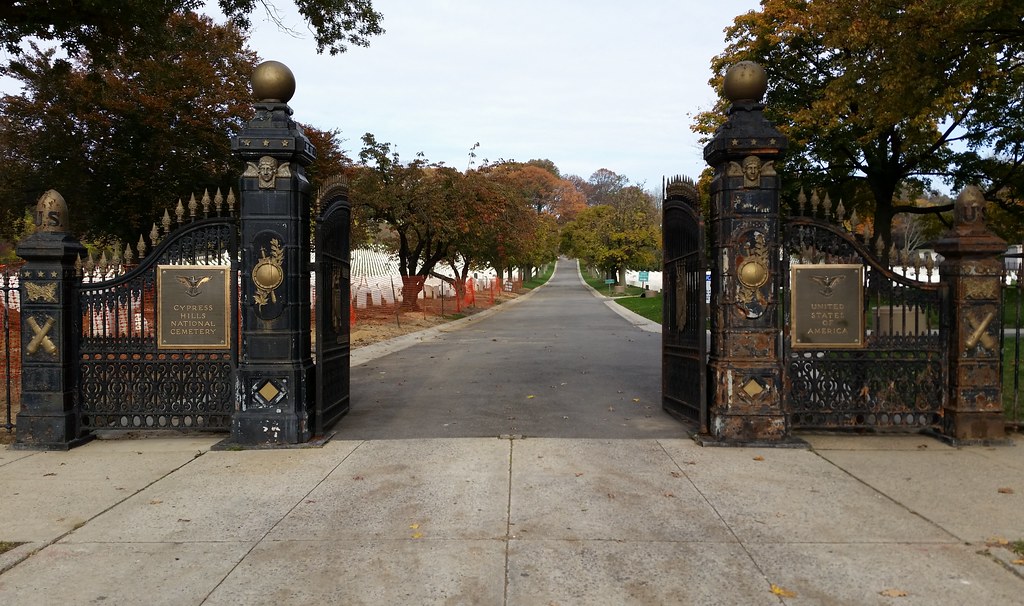
Cypress Hills National Cemetery, the only national cemetery in the five boroughs, was one of the 14 original national cemeteries established in 1862 in response to the mounting death toll of the Civil War. (There were no Civil War battles fought in New York, but there were plenty of soldiers dying in the area's military hospitals.) The oldest section of the cemetery is actually located inside a nearby private cemetery named, confusingly, Cypress Hills Cemetery. The main section, above, was purchased by the federal government in 1884. And a very small third section, also located inside Cypress Hills Cemetery, was added in 1941.
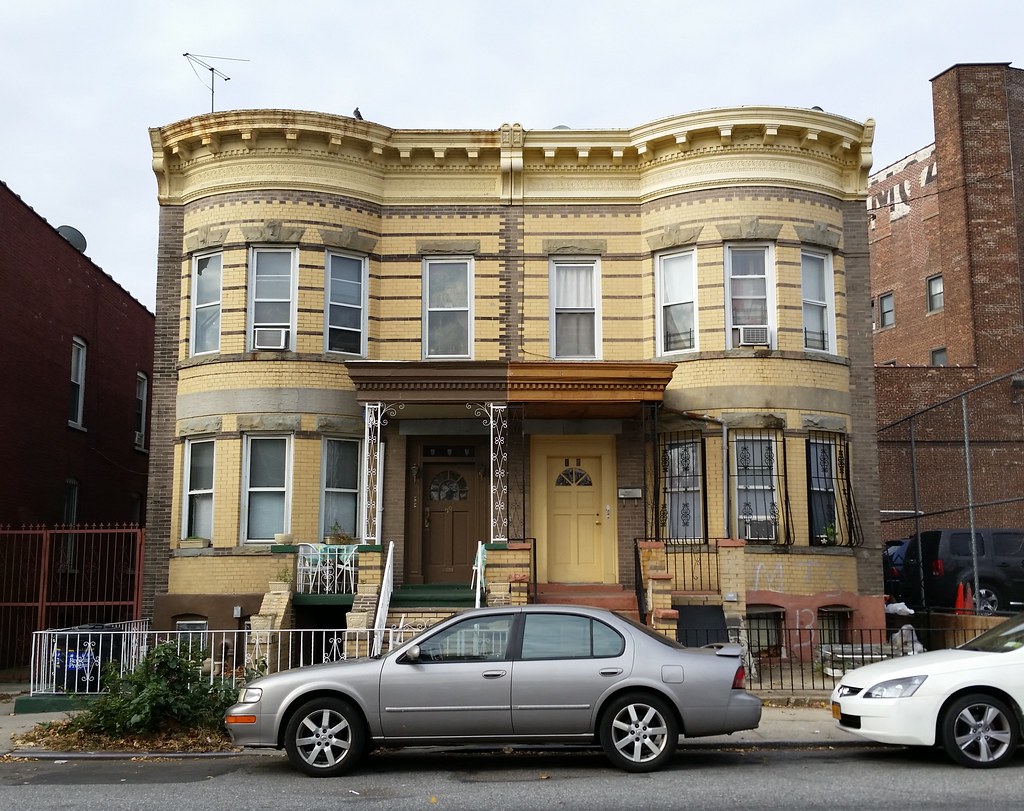
Highland Place seems like a pretty straightforward name for a street that serves as a continuation of Highland Boulevard as it heads south from Highland Park and the high land of the Harbor Hill Moraine. But the way in which Highland Place acquired its rather boring name is actually quite interesting.
During and shortly after America's involvement in World War I, anti-German sentiment in the country reached a fever pitch, stoked by US government propaganda ("DESTROY THIS MAD BRUTE", for example). This hostility manifested itself in many ways, some violent and some simply ridiculous.
Sauerkraut consumption plummeted precipitously, "owing to the prejudice that had developed against the use of a food of such unmitigated German origin". In a move that recalls the freedom fries fiasco of 2003, a delegation of vegetable dealers petitioned the Federal Food Board in April of 1918 to change the name of sauerkraut to something like "liberty cabbage" or "pickled vegetable" in hopes of stimulating sales and preventing the "immense quantities" already produced from going to waste. The idea caught on in at least some quarters: I've found several grocery store newspaper ads from that era that mention liberty cabbage. The name must have been quite familiar to customers, because the ads don't even bother to explain that it's another term for sauerkraut.
(A couple of weeks after the war ended, American soldiers in Belgium discovered many tons of sauerkraut at an abandoned German supply depot. Along with the other food found there, the sauerkraut was taken by the Army and served to the troops for the next however-many-meals-it-takes-to-eat-that-much-liberty-cabbage. The Brooklyn Daily Eagle remarked: "At Arlon, Belgium, five carloads of sauerkraut were first converted into 'Liberty cabbage' and then converted into Liberty brawn and muscle without delay. Prejudices of the palate are easily overcome.")
Sauerkraut wasn't the only German-sounding thing to get a new wartime name. Hamburgers were rebranded "liberty steaks", frankfurters became "liberty dogs", and German measles were dubbed "liberty measles". When I read about that last one (in an article that also claimed that "liberty pup" was used as a euphemism for "dachshund" and that Cincinnati banned pretzels from the free lunch counters of its saloons), I couldn't believe it. It sounded like an absurd urban legend being passed off as a fact. It's one thing to try to remove any hint of your enemy from the stuff you like — food and pets, for example — but why would you replace "German" with "liberty" in the name of a disease?
Well, it turns out it isn't an urban legend at all. It apparently originated with some soldiers at Camp Dix in New Jersey who were stricken with German measles in early 1918. They were tired of being mocked for having such an unpatriotic-sounding illness, so they started a movement to change its name. The new name caught on to some extent at least: "Liberty Measles at West Point" was the NY Times headline when an outbreak occurred at the military academy shortly after the Camp Dix story ran. I even found a fairly technical article published in the March 1920 bulletin of the NYC Department of Health that refers to the disease solely by the patriotic version of its name, with sentences like: "It serves to differentiate the beginning of measles rash from other rubeoliform eruptions—Liberty measles, variola, antitoxin rashes, vaccination rashes, drug eruptions, multiform erythema and similar eruptions."
NYC joined in on the fun by renaming a few streets that, "to the offense and humiliation of our citizens", bore German-inspired (or Austrian-inspired) appellations. In the Bronx, German Place became Hegney Place, named for Arthur Vincent Hegney, the first Bronx soldier to die in the war. In Brooklyn, Bremen Street became Stanwix Street, Vienna Avenue became Lorraine Avenue (which no longer exists; it was partially incorporated into Linden Boulevard, with other sections becoming Dewitt Avenue and Loring Avenue), Hamburg Avenue became Wilson Avenue, presumably named for Woodrow Wilson, the sitting president at the time (a rare instance of a street being named for a living person), and — finally getting back to the starting point of this whole discussion — Dresden Street became Highland Place.
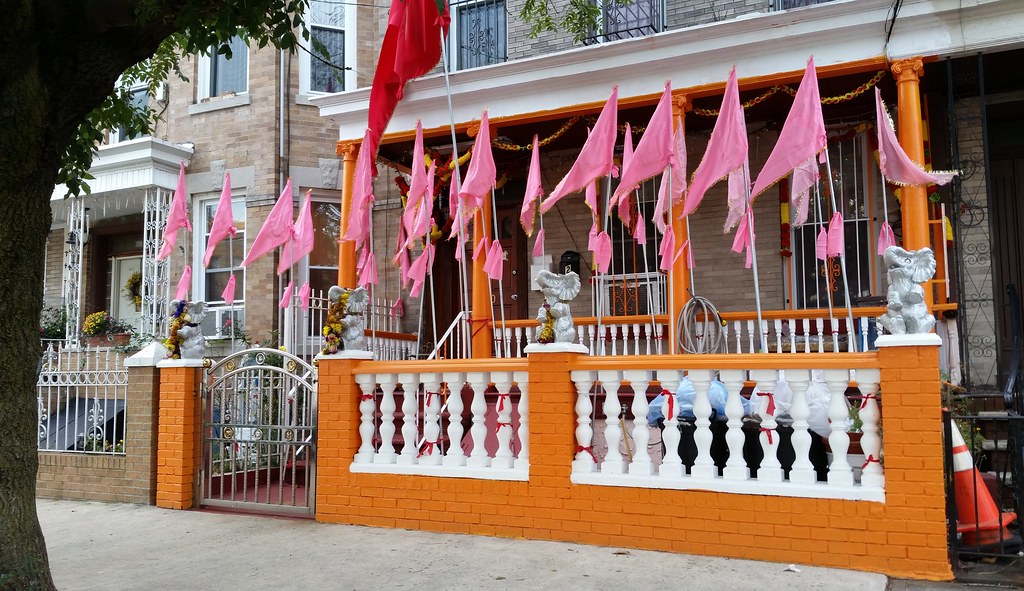
A guy who lives here told me they decorate the house for each Hindu holiday. He said the most recent one was about a week ago and involved bathing at the beach. Kartik Poornima?
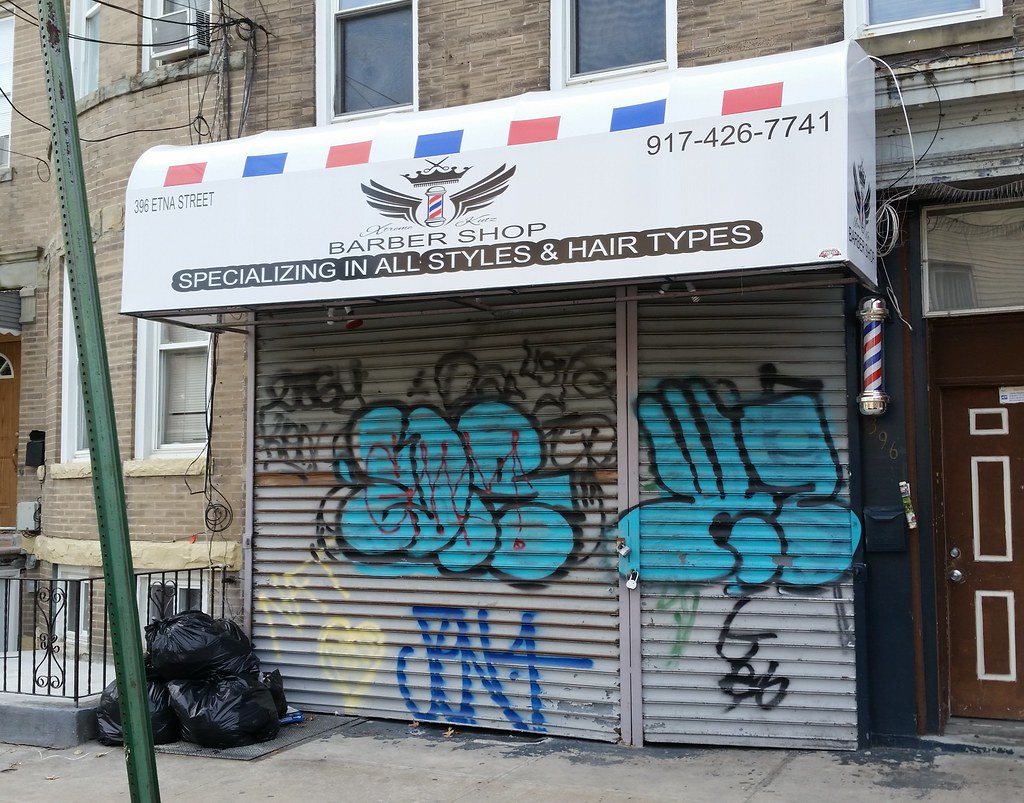
Xtreme Kutz
(This was originally Barberz #104, but I renumbered it to fill in the gap created when I downgraded the former Barberz #20.)


This firehouse is the former site of 9/11 memorial #121. I wonder how many other memorials have disappeared in the time since I saw them.
As suggested by the "B.F.D." over the garage door, FDNY Engine Company 236 is a big fuc— I mean, was originally part of the Brooklyn Fire Department. It began its life as BFD Engine Company 36 back in 1895, when Brooklyn was still an independent city and had its own fire department.

With the help of a little paint, this presumably pineapple-inspired gatepost ornament has transformed into something more reminiscent of a strawberry.


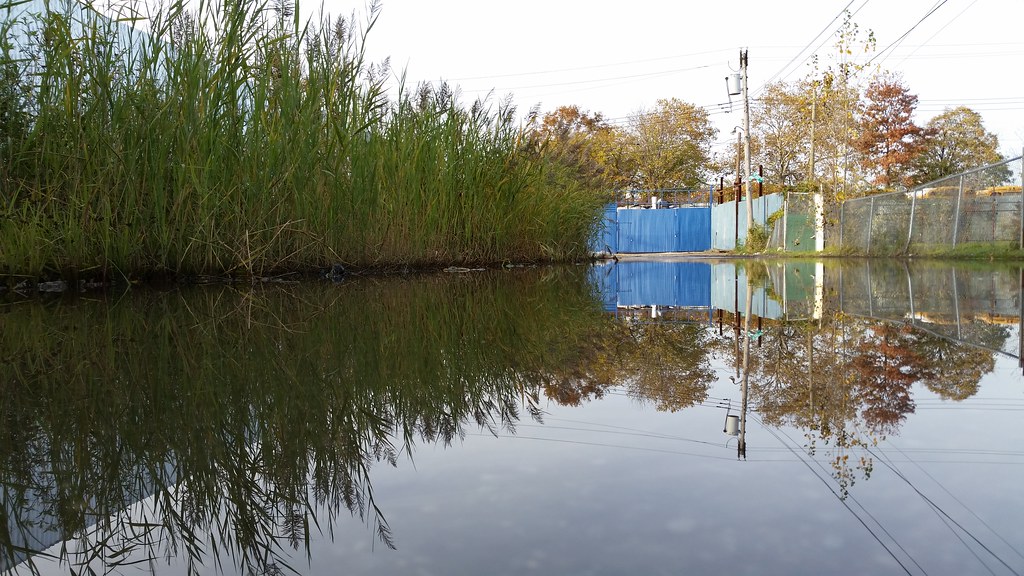
A visit to the strange, sewerless world of the Hole generally involves navigating multiple stretches of flooded roadway. Fortunately, in this case, there was a raised area on the left side of the street that I was able to walk along.
I'm walking every street in New York City.
This is the counterpoint to my walk across the US. Instead of seeing a million places for just a minute each, I'm going to spend a million minutes exploring just one place. By the time I finish walking every block of every street in all five boroughs, I'll have traveled more than 8,000 miles on foot — all within a single city. Details!
Email me at matt@imjustwalkin.com
Subscribe to my email list
Maps: Progress | Photos

Your donations allow me to keep walking full-time. If you think what I'm doing is valuable and you'd like to offer some support, I would be very grateful. On the other hand, if you think I'm a worthless bum, feel free to email me and tell me to get a job, bozo. Both are excellent options!
