
Returning to the racecourse once again, I came upon these women who had traveled here from Canada to perform for the runners. (Check out this clearer shot and better recording of them.) I was quite taken with them and their music, so ethereal and fragile that it seemed to be blowing in on the wind. Standing there listening to them, I was almost overtaken by the beauty of the whole scene, when, seemingly out of nowhere, Atmavir passed by bouncing his ball.* I thought my heart was going to explode!
* Atmavir is the runner in the yellow shirt who walks by with about 19 seconds remaining. He often bounces a handball on the sidewalk as he runs around the course! The particular bounce mentioned above occurs just after he passes out of frame, but you can catch a glimpse of the yellow ball in his left hand as he goes by.

It's not unusual to see a black squirrel running around NYC these days, but this two-toner is sporting a brown tail!

We've already encountered, on two previous visits to the area, the puny little dead-end street (which has at least been marked with a street sign since Kevin Walsh took his literary spin through the neighborhood) named for the Bronx's master of the macabre. While a dark alley may seem a fitting tribute to a man often portrayed as a perpetual inebriate, it's nice to see he's been honored in a more dignified manner as well, with the preservation of his house and the recent construction of a visitor center (which is still unoccupied, though perhaps not for too much longer) in the surrounding park.
Edgar Allan Poe spent the last few years of his short life in this cottage, originally located just down the street on Kingsbridge Road in what was then Fordham Village. He moved here in 1846 with his wife (first cousin) Virginia and mother-in-law (aunt) Maria, hoping the fresh country air would alleviate Virginia's tuberculosis. She died less than a year later, however, and Poe was heartbroken. Many suspect his final completed poem, one of several works penned here in the Bronx, was an expression of this loss.
For the moon never beams, without bringing me dreams
Of the beautiful Annabel Lee;
And the stars never rise, but I feel the bright eyes
Of the beautiful Annabel Lee;
And so, all the night-tide, I lie down by the side
Of my darling—my darling—my life and my bride,
In her sepulchre there by the sea—
In her tomb by the sounding sea.

In its glory days, this concert space hosted some pretty big names, including Jimmy Dorsey, Benny Goodman, and Glenn Miller.
This mahogany pole, adorned with text from Walt Whitman's The Centenarian's Story, is one of a series of installations marking sites from the Battle of Brooklyn (a.k.a. Battle of Long Island), which was the first, and largest, major battle of the Revolutionary War, and could have been the last if the Americans had not managed a massive escape by boat across the East River to Manhattan.
From the vantage point of Cobble Hill Fort, which once stood near this spot, General George Washington monitored the action that day, and watched the sacrifices made by the gravely outnumbered Maryland 400 (remember them?), whose desperate, last-ditch counterattack provided cover for other soldiers to escape across Gowanus Creek, and bought time for the rest of the Americans to evacuate to Manhattan.
Now part of the Brooklyn Heights Montessori School, this building served as a fire insurance salvage corps station from the time it was completed in 1909 until 2006, when the New York Fire Patrol, which had taken over the station in 1910 and was the last surviving salvage corps in the nation, was finally disbanded and its three remaining stations shuttered.
Until it was sold in 2008, this building (scroll to page 3) was owned by Long Island College Hospital (LICH), having been constructed in 1897 to provide free medical care for the area's poor, and classroom and laboratory space for the college. Possibly the first skyscraper hospital ever built, it was a top-of-the-line facility in its early days, housing one of the world's first X-ray machines.
LICH, now part of SUNY Downstate Medical Center, began its life in 1856 as the Brooklyn German General Dispensary, intended to serve the poor German immigrants who lived nearby (much like the German Dispensary we saw in the East Village). Rapidly broadening its scope, it had by 1858 become Long Island Hospital and Medical College, the first teaching hospital in the US. It was an influential institution in its day, introducing bedside teaching as a standard part of medical training, and becoming the country's first hospital to use stethoscopes and anesthesia. One of its early graduates was Alexander Skene, the gynecologist locked in a staring contest with JFK.
But perhaps most importantly, its innovative treatments led to a 1925 NY Times article that contains what must be one of the greatest opening lines in the history of journalism: "Thirty patients regarded as hopelessly insane are back at work and leading normal lives after being artificially inoculated with malaria".
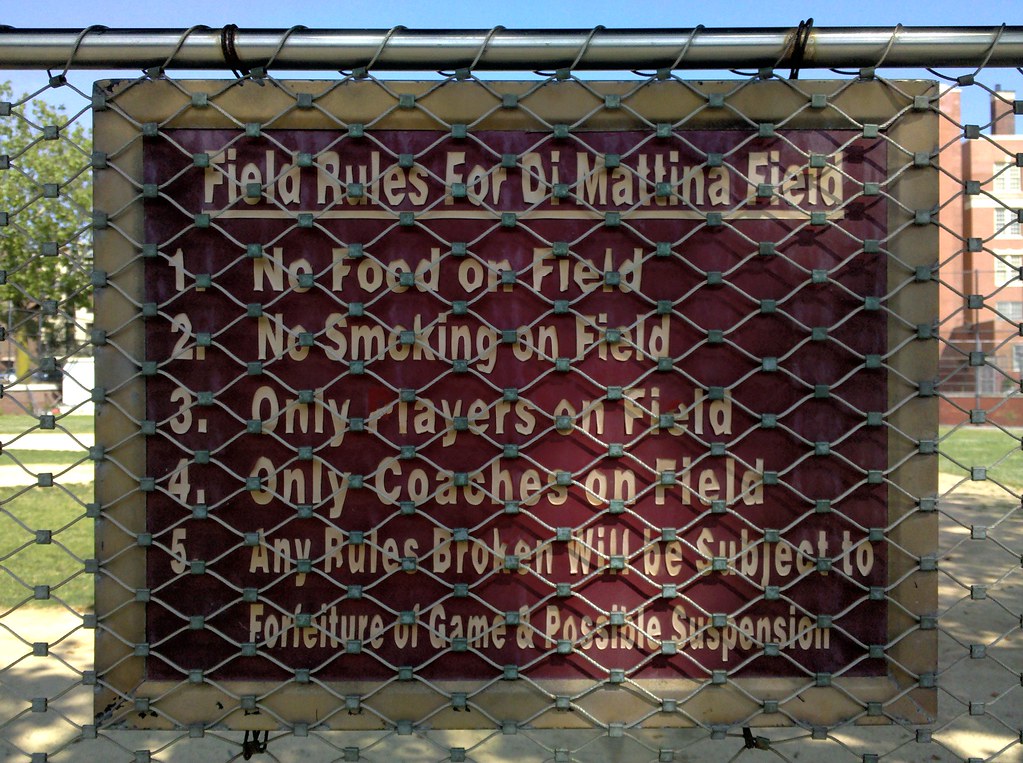
These sea stars sit atop the entrance to Di Mattina Field, a baseball diamond owned by the Parks Department.
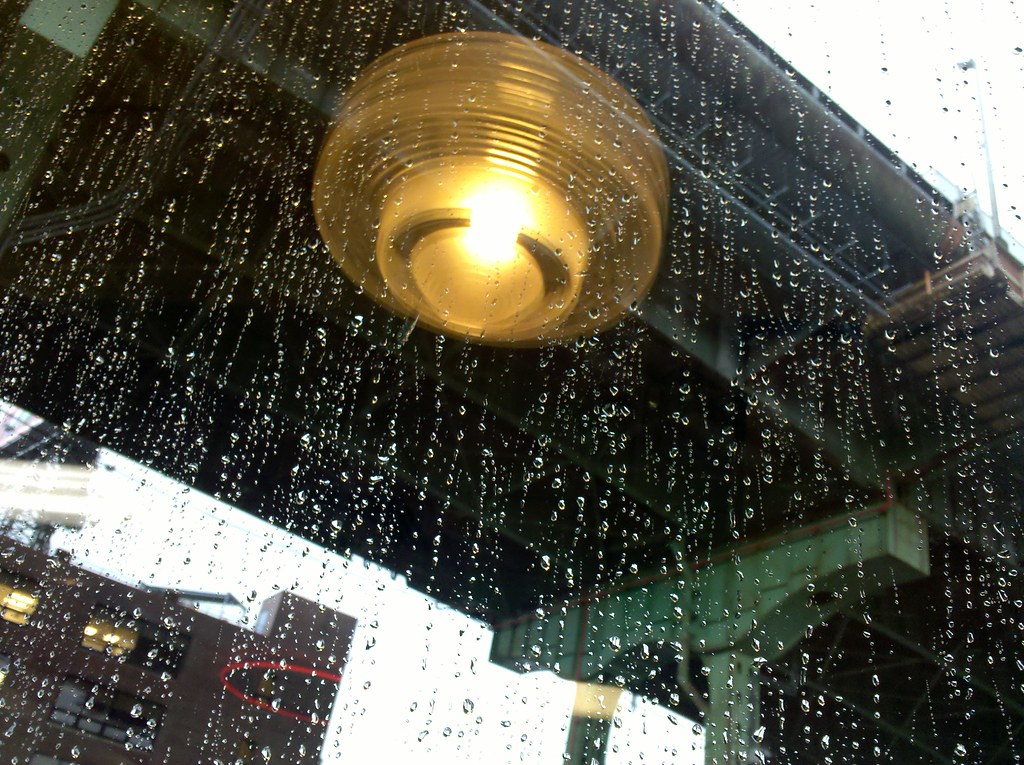
I happened upon this well-windowed fast food restaurant beneath the BQE just as the skies were opening.
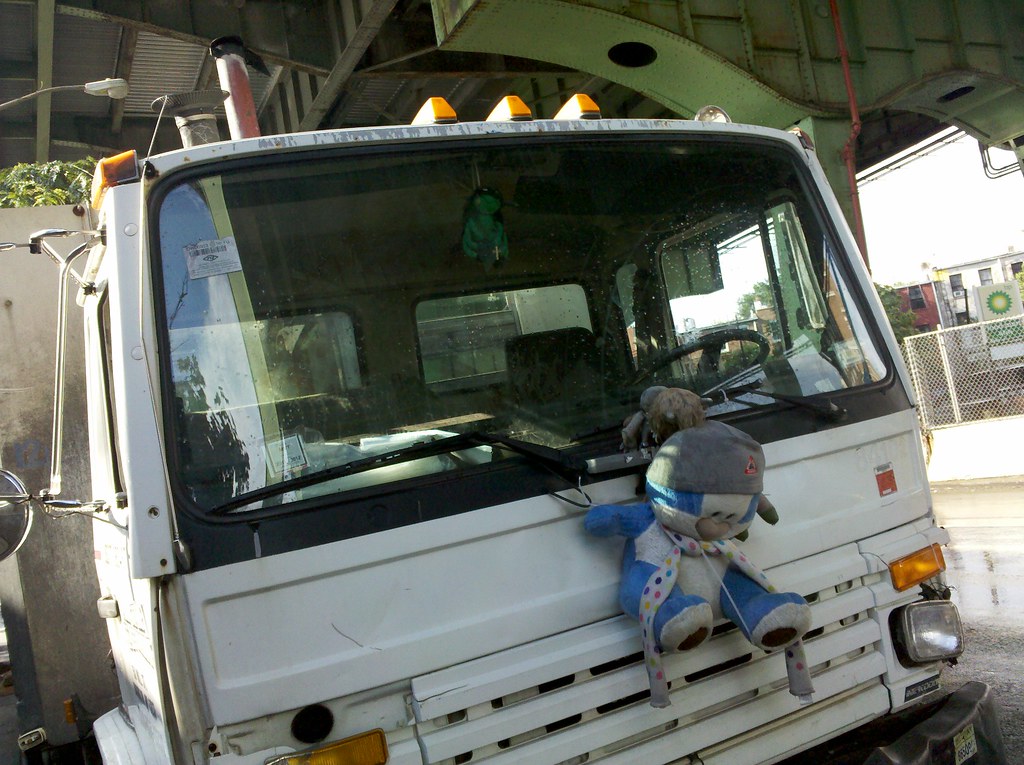
This bear-like creature is part of a "traveling gallery of baldly transgressive public art."
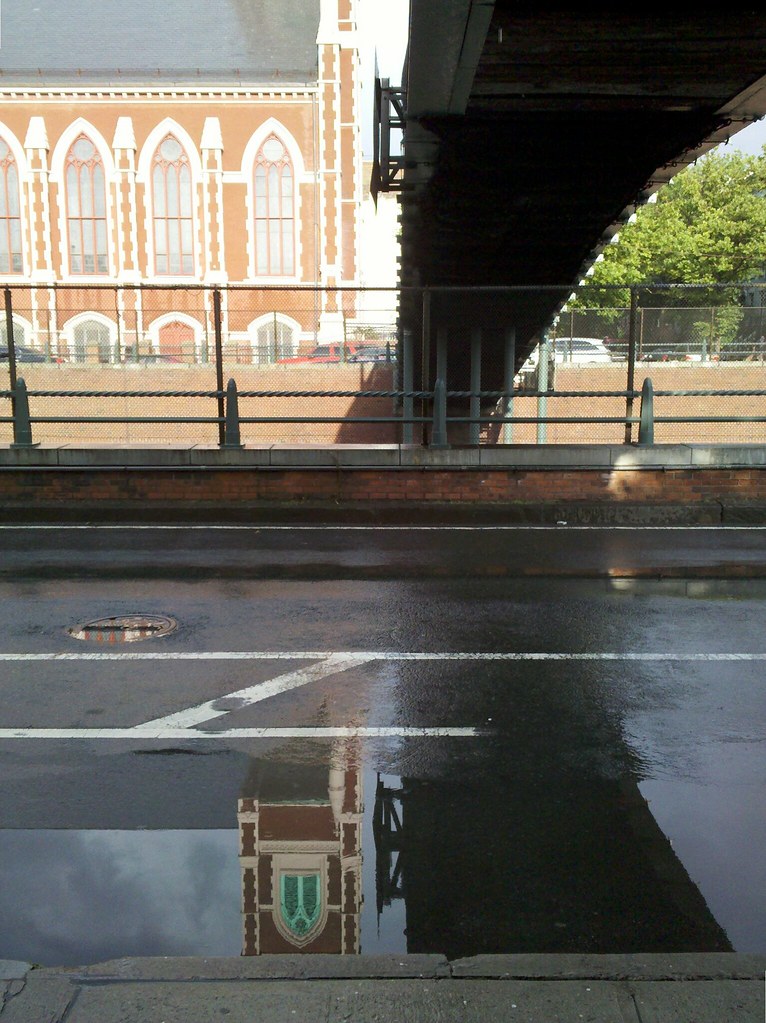
Completed in 1875, this neo-Gothic structure was built by the Parish of St. Stephen. The Church of the Sacred Hearts of Jesus and Mary, once located about half a mile north of here, was condemned in 1941 to make way for the BQE (which you can see in this photo being traveled by the white car and red bus), and the two parishes merged.
Since 1940, commercial billboards located closer than 200 feet to a highway have been illegal in NYC (unless they're advertising the business on whose property they stand), but this ban has regularly been flouted for decades without much in the way of consequences. Recently, however, the city has started enforcing the law, and the owner of this billboard has adapted. Back in 2009, you could find a seemingly risqué advertisement for a proctology clinic on this structure, but by 2011, all three sign faces were promoting non-commercial organizations — the New York Lottery, the Alzheimer's Foundation of America, and the YAI Network — bringing the billboard into compliance with regulations, though not doing anything to reduce visual distractions on the BQE. (Back in January, as you may recall, a different lottery billboard — this one illegal, because it also bore an ad for Dunkin' Donuts — toppled onto the BQE.)
The newest of three such facilities in the NYC area, the Brooklyn Cruise Terminal in Red Hook opened to much fanfare in 2006 with the docking of the Queen Mary 2 (which had just lost its title as the world's largest cruise ship but was still the world's longest cruise ship, by 20 feet).
Here's the story behind that lone R on the billboard to the left.
The Summit Street pedestrian bridge, like its much larger cousin, is ornamented with quite a few of these.
Erected after successful eye surgery in 1969, the patron saint of the blind has kept watch over the corner of 3rd Place and Court Street in Carroll Gardens ever since.
This replica of the statue that stands in the center of the Italian town of Mola di Bari, honoring its patron saint, is the focal point of the garden outside the Van Westerhout Cittadini Molesi Social Club, a gathering place for men from Mola. (Here's a substantial, though sloppily reported — Mola has 26,000 residents, not 2,500, for example — look inside the club.) Twice a year, a similar Madonna kept at Sacred Hearts-St. Stephen’s is paraded around the streets of Carroll Gardens for hours, accompanied by musicians and throngs of marchers.

The state's Congressional primaries were held months earlier than usual this year.

Located on the sidewalk outside the ASPCA's former Brooklyn headquarters, this trough (now filled in with concrete) was one of several around the city installed by the organization in the early 1900s.


The red barn-shaped building with the gray roof houses the pumps for the 1.2-mile-long Gowanus Canal flushing tunnel, which delivers relatively clean water from Buttermilk Channel into the stagnant, highly polluted canal. This increases oxygen levels in the canal, mitigating unpleasant odors and making the waters habitable for aquatic life. The tunnel is currently out of service while it's being repaired and upgraded; to compensate, the Department of Environmental Protection has installed a temporary system that injects oxygen into the waters of the canal.
When it opened in 1911, the tunnel was seen as a "long-looked-for emancipation from the evil smells of old Gowanus". Much fanfare accompanied its activation: decorated yachts and barges floated down the canal, and a young woman was crowned Miss Gowanus.
You can also spot a greenish-yellow birdhouse in this photo, mounted on one of the trees lining the canal. It was built and installed as part of an effort to provide attractive lodging for the various winged creatures that live along the Gowanus.

Seeing their van parked on this grimy street beside the Gowanus Canal, you'd never imagine Day & Meyer's Portovaults hold some of New York's most valuable possessions.


Celebrating the miracle of the city's water supply system (here's a closer look)

Welcome to Green-Wood Cemetery, one of the first, and grandest, examples of an American rural cemetery. Founded in 1838 on 478 magnificently wooded acres of glacial hills and dales, it once rivaled Niagara Falls as the country's premier tourist attraction. There's too much to see in just one day, so I'll be back for at least a few more visits over the next two years.
You may be able to discern a brown blob emerging from the base of the spire atop the gateway's central tower. It's a gigantic nest built by the famed Brooklyn parrots; Green-Wood is one of their strongholds.

This memorial must have been installed just a couple of years ago, when the beloved Williamsburgh Savings Bank Tower lost its long-held title of Tallest Building in Brooklyn.

The Altar to Liberty, a 1919 commemoration of the Battle of Long Island, stands on Battle Hill, an American defensive position taken by the British as the first major conflict of the Revolutionary War unfurled across Brooklyn. The Roman goddess Minerva stands upon the altar, facing the Statue of Liberty across the harbor. A few years ago, there was a controversial development being proposed just outside the cemetery, and, to ensure that the new four-story buildings would not obstruct the line of sight between the two ladies, a worker at the site was hoisted 40 feet into the air in a cherry picker while cemetery officials looked on from Minerva's side. They were still able to see Miss Liberty above the worker's head, and so they gave their approval to the developer's plans.


is the summit of the hill in the background, standing 220 feet above sea level and occupied by the mausoleum of Philip and Latifee Kiamie.
Mr. Stoiber's headstone, in the foreskin foreground, is, especially when viewed from behind, perhaps the most priapic monument in the entire cemetery, a place that certainly suffers no shortage of priapicity!
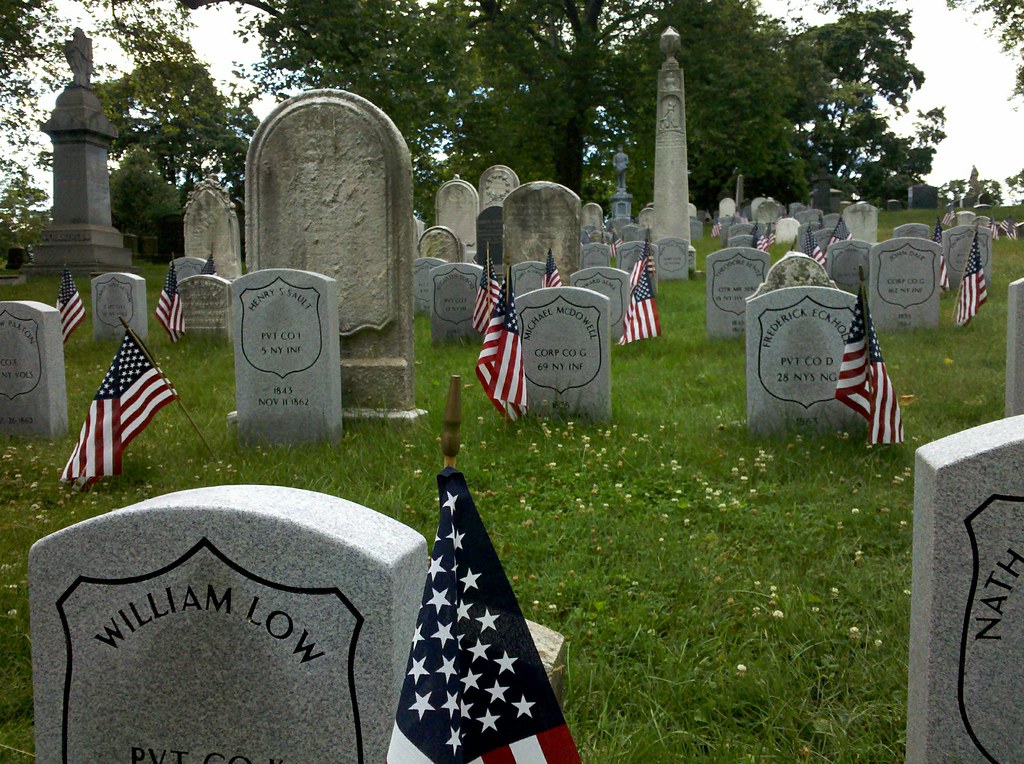
In 1863, this modestly sized section of Green-Wood was donated for soldiers who died in the Civil War. But many others who served are buried throughout the cemetery's 478 acres. Thanks to an extraordinary volunteer effort over the past decade, almost 5,000 Civil War veterans and counting (far more than the few hundred that were expected) have been identified in Green-Wood, including some Confederates, and some 2,000 new markers (like the ones you see here) have been obtained from the Department of Veterans Affairs for those whose gravestones were lost (often vanished into the ground over time) or damaged or perhaps never existed in the first place.

Brooklyn's first Civil War casualty, 12-year-old Clarence MacKenzie was accidentally shot and killed by another member of his regiment during a drill. He was originally buried elsewhere in the cemetery, but was then relocated to the Soldiers’ Lot (visible at back in the previous picture), where his grave was marked with this monument.

After lying in an unmarked grave for more than a century, the painter of "The Bulls and Bears in the Market" was spectacularly memorialized in 2002.

Neither he nor his wife nor his daughter are buried here? Thanks to this memorial, I just learned a new word.


